Key points
- Mass defect is the difference between the mass of the separate nucleons and the mass of the nucleus.
- Binding energy = Δmc², and 1 u is equivalent to about 931.5 MeV.
- The binding energy per nucleon curve peaks near iron-56 and nickel-62, at about 8.8 MeV.
- Fusion of light nuclei and fission of heavy nuclei both move products up the curve and release energy.
- Nucleon number and charge are conserved in every nuclear equation.
What binding energy and mass defect mean
Binding energy and mass defect are two views of the same fact: a nucleus has less mass than its separate protons and neutrons, and the missing mass has been released as energy. The mass defect is Δm = Zmₚ + (A − Z)mₙ − m(nucleus), and the binding energy is E = Δmc², the energy needed to pull the nucleus apart into free nucleons.
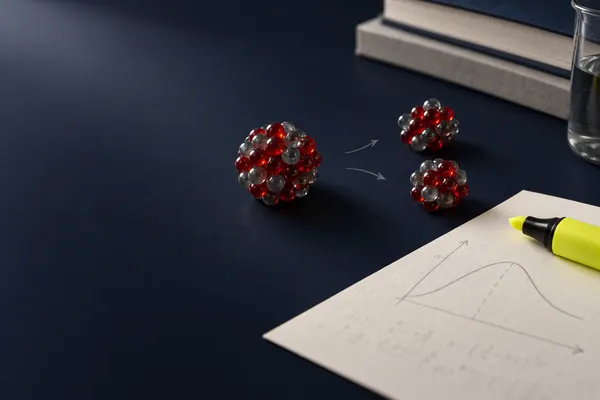
Think about building a nucleus from free protons and neutrons. The strong nuclear force pulls them together, and as they fall into the bound state, energy is given out (as photons or kinetic energy). Energy has mass, so the finished nucleus has less mass than the parts. To undo the process you must put the same energy back in.
This is not a loss of mass that vanishes. Mass and energy are two forms of one conserved quantity, which is why the equation E = mc² links them. In everyday chemistry the mass changes are far too small to measure. In nuclear physics the energy changes per reaction are roughly a million times bigger, so the mass differences can be measured and they matter.
E = mc² and the atomic mass unit
E = mc²
- E = energy / J
- m = mass / kg
- c = speed of light = 3.00 × 10⁸ m s⁻¹
For a change: ΔE = Δmc².
Nuclear masses are tiny in kilograms, so physicists use the unified atomic mass unit, u. One u is one twelfth of the mass of a carbon-12 atom, which is 1.661 × 10⁻²⁷ kg. Particle masses in u are easier to handle: a proton is 1.00728 u and a neutron is 1.00867 u.
Energies are usually given in megaelectronvolts, MeV. One electronvolt is 1.60 × 10⁻¹⁹ J, so 1 MeV = 1.60 × 10⁻¹³ J. Combining these, one atomic mass unit is equivalent to about 931.5 MeV.
1 u ≈ 931.5 MeV (1 u = 1.661 × 10⁻²⁷ kg)
1 MeV = 1.60 × 10⁻¹³ J. Mass defect in u × 931.5 gives binding energy in MeV.
Mass defect and binding energy of a nucleus
To find the mass defect of a nucleus with A nucleons and Z protons, add up the masses of Z free protons and (A − Z) free neutrons, then subtract the mass of the nucleus.
Δm = Zmₚ + (A − Z)mₙ − m(nucleus)
- Δm = mass defect / u or kg
- Z = proton number
- A = nucleon number
- mₚ, mₙ = proton and neutron masses
binding energy = Δmc² and binding energy per nucleon = Δmc² / A
Watch out for atomic masses compared with nuclear masses. A data table might give the mass of the atom, which includes the electrons. If you are given the nuclear mass, use free proton and neutron masses as above. If a question gives atomic masses, it will normally say how to account for electrons, so read it carefully.
The binding energy per nucleon tells you how tightly bound the average nucleon is. A higher value means a more stable nucleus. This is the quantity plotted in the famous curve.
The binding energy per nucleon curve
Plotting binding energy per nucleon against nucleon number A gives a curve with a distinctive shape. It rises steeply for the lightest nuclei, has a small spike at helium-4, climbs more slowly to a broad maximum near iron-56, then declines gently for the heaviest nuclei.
You should be able to read three things from it. First, the peak, which is where nuclei are most tightly bound. Second, that the very light nuclei have a low value, so joining them (fusion) can release energy. Third, that the heaviest nuclei sit lower than medium nuclei, so splitting them (fission) can release energy. Helium-4 is unusually tightly bound for its size, which is why it appears in so many decays, as the alpha particle.
| Nuclide | A | Binding energy per nucleon / MeV |
|---|---|---|
| Hydrogen-2 | 2 | 1.1 |
| Helium-4 | 4 | 7.1 |
| Carbon-12 | 12 | 7.7 |
| Calcium-40 | 40 | 8.6 |
| Iron-56 | 56 | 8.8 |
| Tin-120 | 120 | 8.5 |
| Lead-208 | 208 | 7.9 |
| Uranium-235 | 235 | 7.6 |
Why iron-56 sits near the peak
The shape comes from a competition between two forces. The strong nuclear force attracts every nucleon to its close neighbours, but it only acts over a few femtometres. A nucleon in the middle of a nucleus feels the force from all its neighbours. A nucleon at the surface has fewer neighbours, so it is held less tightly. The electrostatic repulsion between protons acts over long range, so each extra proton is repelled by all the others.
- Light nuclei: a large fraction of nucleons are at the surface, with fewer neighbours, so the binding energy per nucleon is low.
- Medium nuclei: most nucleons are surrounded by neighbours, and the repulsion between protons is still modest, so the binding energy per nucleon is highest.
- Heavy nuclei: the number of protons is large and the long-range repulsion builds up faster than the short-range attraction, so the binding energy per nucleon falls.
Iron-56 and nickel-62 sit at the top of the curve, at about 8.8 MeV per nucleon. Strictly, nickel-62 has the highest binding energy per nucleon, with iron-56 very close, and iron-56 is the usual example in textbooks and exams. In stars, fusion releasing energy proceeds up to roughly this point, and beyond it, fusion no longer releases net energy.
Fission and fusion energy release
Nuclear fission is the splitting of a heavy nucleus into two medium-sized nuclei, usually after absorbing a neutron, together with a few free neutrons. The products are higher up the curve than the original nucleus, so the total binding energy increases and the difference is released, mostly as the kinetic energy of the fragments. A typical figure is about 200 MeV for each fission of uranium-235, much of it carried by the fragments.
Nuclear fusion is the joining of two light nuclei into a heavier one. Again, the product is higher up the curve, so energy is released. The difficulty is that both nuclei are positive, so they repel. To fuse they need enough kinetic energy to overcome the electrostatic repulsion, which means temperatures of the order of 10⁷ K in the Sun's core, or higher in a laboratory reactor.
To calculate the energy released from the curve, use total binding energy before and after. For each nuclide, total binding energy = (binding energy per nucleon) × A. Then energy released = total binding energy of products − total binding energy of reactants. Free neutrons have zero binding energy, so they add nothing to the total.
Conservation rules in nuclear equations
In every nuclear reaction, the total nucleon number (A, the superscript) and the total charge, shown by the proton number (Z, the subscript), are the same on both sides. Mass-energy is also conserved overall, which is where the released energy comes from. Lepton number is conserved in beta decay, which is why an antineutrino appears alongside a beta-minus particle.
- Alpha decay: ²³⁸₉₂U → ²³⁴₉₀Th + ⁴₂He. Top numbers: 238 = 234 + 4. Bottom numbers: 92 = 90 + 2.
- Beta-minus decay: ¹⁴₆C → ¹⁴₇N + ⁰₋₁e + ν̄ₑ. A neutron changes into a proton, so Z goes up by 1 and A is unchanged.
- Fission: n + ²³⁵₉₂U → ¹⁴¹₅₆Ba + ⁹²₃₆Kr + 3 n. Top: 1 + 235 = 236 = 141 + 92 + 3. Bottom: 92 = 56 + 36.
A quick tip when completing an equation is to balance the top row first, then the bottom row, and then identify the missing particle from its A and Z. See radioactive decay and half-life for how decay rates work and how alpha and beta particles behave.
Worked examples
Binding energy of helium-4
A helium-4 nucleus has a mass of 4.00151 u. The mass of a proton is 1.00728 u and of a neutron 1.00867 u. Calculate (a) the mass defect, (b) the binding energy in MeV and (c) the binding energy per nucleon. Use 1 u = 931.5 MeV.
- (a) Helium-4 has Z = 2 and N = 2. Mass of separate nucleons = 2 × 1.00728 + 2 × 1.00867 = 2.01456 + 2.01734 = 4.03190 u.
- Mass defect = 4.03190 − 4.00151 = 0.03039 u.
- (b) Binding energy = 0.03039 × 931.5 = 28.3 MeV.
- (c) Per nucleon = 28.3 / 4 = 7.08 MeV.
Answer (a) 0.0304 u (b) 28.3 MeV (c) 7.08 MeV per nucleon
Using E = mc² in SI units
Using the same mass defect of 0.03039 u, calculate the binding energy of helium-4 in joules, using u = 1.661 × 10⁻²⁷ kg and c = 3.00 × 10⁸ m s⁻¹. Convert it to MeV.
- Δm = 0.03039 × 1.661 × 10⁻²⁷ = 5.05 × 10⁻²⁹ kg.
- E = Δmc² = 5.05 × 10⁻²⁹ × (3.00 × 10⁸)² = 5.05 × 10⁻²⁹ × 9.00 × 10¹⁶ = 4.54 × 10⁻¹² J.
- In MeV: 4.54 × 10⁻¹² / 1.60 × 10⁻¹³ = 28.4 MeV.
Answer E = 4.5 × 10⁻¹² J = 28.4 MeV (agrees with 28.3 MeV within rounding)
Energy released by fusion
Deuterium and tritium fuse: ²₁H + ³₁H → ⁴₂He + ¹₀n. The nuclear masses are: deuterium 2.01355 u, tritium 3.01550 u, helium-4 4.00151 u, neutron 1.00867 u. Calculate the energy released in MeV and in joules.
- Mass before = 2.01355 + 3.01550 = 5.02905 u.
- Mass after = 4.00151 + 1.00867 = 5.01018 u.
- Mass lost = 5.02905 − 5.01018 = 0.01887 u.
- Energy = 0.01887 × 931.5 = 17.6 MeV.
- In joules: 17.6 × 1.60 × 10⁻¹³ = 2.81 × 10⁻¹² J.
Answer 17.6 MeV = 2.8 × 10⁻¹² J per reaction
Fission from the binding energy curve
A uranium-235 nucleus absorbs a neutron and splits: n + ²³⁵₉₂U → ¹⁴¹₅₆Ba + ⁹²₃₆Kr + 3 n. Binding energies per nucleon (read from a curve) are: uranium-235 7.59 MeV, barium-141 8.33 MeV, krypton-92 8.51 MeV. Estimate the energy released.
- Total binding energy of U-235 = 235 × 7.59 = 1783.65 MeV.
- Ba-141: 141 × 8.33 = 1174.53 MeV. Kr-92: 92 × 8.51 = 782.92 MeV. Total of products = 1957.45 MeV.
- Free neutrons have no binding energy, so they add nothing.
- Energy released = 1957.45 − 1783.65 = 173.8 MeV.
Answer About 1.7 × 10² MeV. This is an estimate because the per-nucleon values come from reading a graph.
Mass converted in the Sun
The Sun radiates energy at a rate of 3.8 × 10²⁶ W. Calculate the mass converted to energy each second.
- Energy per second = 3.8 × 10²⁶ J.
- Δm = E / c² = 3.8 × 10²⁶ / (3.00 × 10⁸)² = 3.8 × 10²⁶ / 9.00 × 10¹⁶.
- Δm = 4.2 × 10⁹ kg.
Answer About 4.2 × 10⁹ kg every second
Common mistakes
- Using the nucleus mass as the mass defect. The defect is the difference between the separate nucleons and the nucleus.
- Forgetting the neutrons. The number of neutrons is A − Z, not A.
- Mixing units. If you use 931.5 MeV per u, the mass defect must be in u, not kg.
- Saying mass 'turns into' energy and disappears. Mass and energy are linked by E = mc², and total mass-energy is conserved.
- Treating the curve's y-axis as total binding energy. It is per nucleon, so multiply by A.
- Saying fission releases energy because the products are lighter nuclei. It is because the products have a higher binding energy per nucleon.
- Saying iron-56 has the highest total binding energy. It has one of the highest values per nucleon. Uranium-235 has a larger total, simply because it has more nucleons.
- Putting free neutrons in the binding energy calculation. A free neutron has no binding energy.
How OCR A examines this topic
This topic belongs in Nuclear and particle physics, within the Particles and medical physics module. Questions normally combine definition, calculation and explanation. Check the current specification for the precise statements.
- Define: mass defect and binding energy, often for 2 marks.
- Calculate: a mass defect from given masses, then a binding energy in MeV or J, then per nucleon.
- Interpret the curve: explain why fusion and fission both release energy, why iron is most stable, or estimate energy released using values read from a graph.
- Complete equations: use conservation of nucleon number and charge to identify unknown nuclei or particles.
Synoptic links include radioactive decay and half-life for the energy in decay, coulombs law and electric fields for the repulsion that fusion must overcome. Stars link to the Hertzsprung-Russell diagram, where fusion powers the main sequence.
Practice questions
A carbon-12 nucleus has a mass of 11.99671 u. Using mₚ = 1.00728 u, mₙ = 1.00867 u and 1 u = 931.5 MeV, calculate the binding energy per nucleon.4 marks
Show the answer
Answer: 7.68 MeV per nucleon
Nucleons: 6 protons + 6 neutrons = 6 × 1.00728 + 6 × 1.00867 = 6.04368 + 6.05202 = 12.09570 u. Δm = 12.09570 − 11.99671 = 0.09899 u. Binding energy = 0.09899 × 931.5 = 92.2 MeV. Per nucleon = 92.2 / 12 = 7.68 MeV.
A nuclear reaction has a mass defect (mass lost) of 0.0305 u. Calculate the energy released in joules and in MeV. Use u = 1.661 × 10⁻²⁷ kg, c = 3.00 × 10⁸ m s⁻¹ and 1 u = 931.5 MeV.3 marks
Show the answer
Answer: 4.6 × 10⁻¹² J; 28.4 MeV
In kg: 0.0305 × 1.661 × 10⁻²⁷ = 5.07 × 10⁻²⁹ kg. E = 5.07 × 10⁻²⁹ × 9.00 × 10¹⁶ = 4.56 × 10⁻¹² J. In MeV: 0.0305 × 931.5 = 28.4 MeV.
Two deuterium nuclei (each of mass 2.01355 u) fuse to form helium-4 (4.00151 u). Calculate the energy released in MeV.3 marks
Show the answer
Answer: 23.8 MeV
Mass before = 2 × 2.01355 = 4.02710 u. Mass lost = 4.02710 − 4.00151 = 0.02559 u. Energy = 0.02559 × 931.5 = 23.8 MeV.
A nuclear power station produces thermal power of 3.0 GW. Each fission releases 200 MeV. How many fissions occur each second?3 marks
Show the answer
Answer: 9.4 × 10¹⁹ per second
Energy per fission = 200 × 1.60 × 10⁻¹³ = 3.2 × 10⁻¹¹ J. Fissions per second = 3.0 × 10⁹ / 3.2 × 10⁻¹¹ = 9.4 × 10¹⁹.
Use the binding energy per nucleon curve to explain why energy is released when light nuclei fuse and when heavy nuclei split.4 marks
Show the answer
Answer: Fusion of light nuclei and fission of heavy nuclei both give products with a higher binding energy per nucleon.
The products are closer to the peak of the curve. Total binding energy = binding energy per nucleon × nucleon number, so the total increases. The increase in binding energy is released, as kinetic energy and radiation. Mass of products is smaller than mass of reactants by Δm = E / c².
Complete the equations: (a) ²³⁸₉₂U → ²³⁴₉₀Th + X; (b) ¹⁴₆C → ¹⁴₇N + Y + ν̄ₑ.4 marks
Show the answer
Answer: (a) X is ⁴₂He, an alpha particle. (b) Y is ⁰₋₁e, a beta-minus particle (an electron).
(a) A: 238 − 234 = 4. Z: 92 − 90 = 2. So X has A = 4, Z = 2: helium-4. (b) A: 14 = 14 + 0. Z: 6 = 7 + (−1). So Y has A = 0 and Z = −1: an electron.
Next steps
Once you can find a mass defect and a binding energy confidently, practise reading energy released from the curve, then try decay problems in radioactive decay and half-life. The repulsion that fusion must overcome is explained in Coulomb's law and electric fields, and the link to stars is in the Hertzsprung-Russell diagram. See the full Particles and medical physics module, or practise this topic with step-by-step marking.
Frequently asked questions
What is mass defect?
Mass defect is the difference between the total mass of the separate protons and neutrons and the mass of the nucleus they form. It is always positive for a stable nucleus. The missing mass has been released as energy when the nucleus formed, and equals the binding energy divided by c².
How do you convert mass defect in u to MeV?
Multiply the mass defect in atomic mass units by 931.5 to get the binding energy in MeV. Alternatively, convert to kilograms using 1 u = 1.661 × 10⁻²⁷ kg, use E = mc² to get joules, and divide by 1.60 × 10⁻¹³ J per MeV. The two routes agree within rounding.
Why is iron-56 so stable?
Iron-56 sits near the peak of the binding energy per nucleon curve. Its nucleons are held by the strong force from many neighbours, while the long-range repulsion between its protons is still modest. Nickel-62 is very slightly higher, but iron-56 is the usual example.
Why does fission release energy?
The fission products are medium-sized nuclei with a higher binding energy per nucleon than the original heavy nucleus. The total binding energy rises, and the difference is released, mainly as kinetic energy of the fragments.
Why does fusion need such high temperatures?
Nuclei are positively charged and repel each other. To get close enough for the strong force to take over, they need very high kinetic energy, which means temperatures of the order of millions of kelvin.
Is 1 u equal to 931.5 MeV exactly?
It is about 931.5 MeV, from the accurate value of c. If you use c = 3.00 × 10⁸ m s⁻¹ and u = 1.661 × 10⁻²⁷ kg, you get about 934 MeV because of rounding. Use whichever value the question gives.
Related guides


Written for the OCR A Level Physics A (H556) specification. Questions are original and written in exam style; they are not taken from OCR papers. Spotted a mistake? Tell us.