Key points
- Newton's law of gravitation: F = −GMm/r². The force is always attractive and follows an inverse square law.
- Field strength g = F/m = −GM/r², and near the Earth's surface g ≈ 9.81 N kg⁻¹ is approximately uniform.
- Gravitational potential Vg = −GM/r is negative, and is zero at infinity.
- The area under a g-r graph equals the change in gravitational potential, and the gradient of a Vg-r graph is −g.
- Gravitational potential energy is Ep = mVg = −GMm/r, and escape velocity is v = √(2GM/R).
- Gravitational and electric fields are both inverse square laws, but gravity is only ever attractive.
Fields: the key idea
A gravitational field is a region of space where a mass experiences a force because of another mass. We describe the field at a point by the gravitational field strength g: the force per unit mass on a small test mass placed there. It is a vector, measured in newtons per kilogram (N kg⁻¹), and it points in the direction a mass would be pulled, towards the centre of the planet or star.
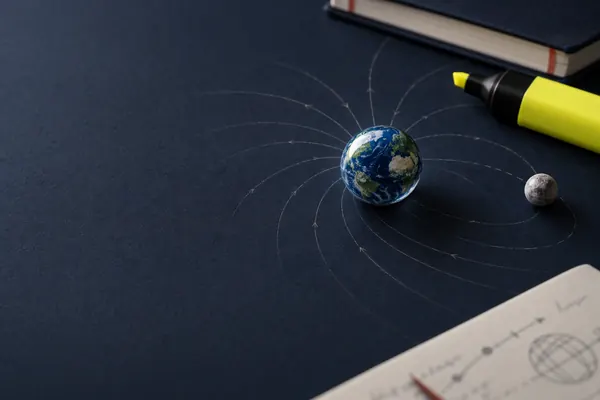
The idea of a field lets us separate two questions. What does the planet do to the space around it? That is the field. What happens to a particular object put in that space? That is the force, F = mg. This split is useful because you can work out the field once and then use it for any mass. It also sets up the later comparison with electric fields.
This guide covers the field strength and potential of a point mass or a uniform sphere, the graphs against distance, potential energy and escape velocity. For circular orbits and Kepler's laws, see the separate guide on Kepler's third law and orbits.
Newton's law of gravitation
Two point masses attract each other with a force that is proportional to the product of the masses and inversely proportional to the square of the distance between them.
F = −GMm/r²
- F = gravitational force in N (the minus sign shows it is attractive)
- G = gravitational constant, 6.67 × 10⁻¹¹ N m² kg⁻²
- M and m = the two masses in kg
- r = distance between their centres in m
Often written as a magnitude, F = GMm/r², with the direction stated separately. A spherical mass acts as if all its mass is at its centre.
The force is always attractive, and the two masses feel equal and opposite forces (Newton's third law), whatever their sizes. Because of the 1/r² dependence, doubling the distance reduces the force to a quarter, and trebling it reduces it to a ninth.
| Distance from centre | Force (relative) |
|---|---|
| r | 1 |
| 2r | 1/4 |
| 3r | 1/9 |
| r/2 | 4 |
The value of G is tiny, so gravitational forces between everyday objects are very small. Two 70 kg people 1.0 m apart attract each other with a force of only 3.3 × 10⁻⁷ N. Gravity only becomes noticeable when at least one of the masses is astronomical.
Gravitational field strength
Divide Newton's law by the small mass m to get the field strength at distance r from a point mass or spherical body of mass M:
g = F/m = −GM/r²
- g = gravitational field strength in N kg⁻¹ (equivalently m s⁻²)
- M = mass producing the field in kg
- r = distance from the centre of M in m
The field strength does not depend on the test mass m.
The field lines around a sphere are radial and point inwards. The lines are closer together where the field is stronger. Close to the surface of the Earth the field is uniform: over a height that is small compared with the radius (6.37 × 10⁶ m), g changes very little, and the field lines are effectively parallel and equally spaced. The surface value is g = GM/R² = (6.67 × 10⁻¹¹ × 5.97 × 10²⁴) ÷ (6.37 × 10⁶)² = 9.81 N kg⁻¹.
The units N kg⁻¹ and m s⁻² are the same, which is why g is also the free-fall acceleration. Be careful with the language in exam answers: a field strength is a force per unit mass, and the acceleration of free fall is how it shows up when only gravity acts. Above the surface, the field falls as 1/r², where r is measured from the centre, not from the surface. At a height of one Earth radius above the surface, r = 2R, so g falls to a quarter of its surface value.
Graphs of field strength against distance
The graph of g against r outside a planet is an inverse square curve. It is not a straight line, and it never quite reaches zero. The graph in the diagram starts at the surface of the Earth, where g = 9.8 N kg⁻¹.
There are two things to be able to do with this graph. First, read values and apply the inverse square law: if r doubles, g falls to a quarter. Second, use the area. The area under a g-r graph between two radii is the change in gravitational potential between those two points. Each thin strip has height g and width Δr, and gΔr is the work done per unit mass in moving through that small distance. Adding the strips gives the total work per unit mass, which is the change in potential. When you are given a g-r graph (for example, of the Moon or another planet), you can find the potential difference by counting squares.
Gravitational potential and potential energy
The gravitational potential Vg at a point is the work done per unit mass in bringing a small test mass from infinity to that point. Because gravity is attractive, the field does the work when the mass moves in, so the work you have to do is negative. The potential is therefore negative everywhere, and the zero of potential is defined to be at infinity.
Vg = −GM/r
- Vg = gravitational potential in J kg⁻¹
- M = mass of the planet or star in kg
- r = distance from the centre in m
The closer you are to the mass, the more negative the potential.
The potential energy of a mass m at that point is the potential multiplied by the mass:
Ep = mVg = −GMm/r
- Ep = gravitational potential energy in J
Two links are worth learning. The first is that the gradient of a Vg-r graph at any point is −g, or g = −ΔVg/Δr. The steep part of the curve close to the planet is where the field is strongest. The second is the change in potential energy when a mass moves between two points: ΔEp = mΔVg. This is the correct approach for large changes in height. For small changes in height near the surface, ΔVg = GM(1/r − 1/(r + h)) ≈ GMh/r² = gh, which gives the familiar ΔEp = mgΔh. That is why the formula mgh works near the surface but not for satellites.
Points at the same distance from the centre of a spherical mass lie on an equipotential surface (a sphere). No work is done moving along an equipotential, because the force is at right angles to the motion.
Escape velocity
The escape velocity is the minimum speed at which an object must be launched from the surface of a planet to escape its gravitational field and reach infinity, ignoring air resistance and the motion of the planet. At infinity the total energy is zero at minimum (zero kinetic energy and zero potential energy), so at the surface the kinetic energy must just cancel the negative potential energy:
½mv² − GMm/R = 0 so v = √(2GM/R)
- R = radius of the planet in m
The mass m of the object cancels, so the escape velocity is the same for every object. It is also √2 times the speed of a circular orbit at the surface.
This also shows why planets hold on to an atmosphere differently. Where the escape velocity is low (the Moon) gas molecules can escape easily. Where it is high (the Earth) they are retained, apart from the lightest gases moving fastest. Note that a rocket does not need to reach the escape velocity at launch, because it can keep firing its engines. The escape velocity applies to a projectile launched once, with no further energy input.
Comparison with electric fields
Gravitational and electric fields share the same mathematical structure, which is why this topic links so well to Coulomb's law and electric fields. Mass plays the role of charge, and G plays the role of 1/(4πε₀) (with a sign change).
| Quantity | Gravitational | Electric |
|---|---|---|
| Force law | F = −GMm/r² | F = Qq/(4πε₀r²) |
| Source | Mass M | Charge Q |
| Field strength | g = −GM/r² | E = Q/(4πε₀r²) |
| Potential | Vg = −GM/r | V = Q/(4πε₀r) |
| Force direction | Always attractive | Attractive or repulsive |
| Field strength is | Force per unit mass | Force per unit positive charge |
| Constant | G = 6.67 × 10⁻¹¹ N m² kg⁻² | 1/(4πε₀) = 8.99 × 10⁹ N m² C⁻² |
| Relative strength | Very weak | Much stronger for charged particles |
There are two main differences to quote in an exam. Gravity is always attractive, because there is only one type of mass, but electric forces can be attractive or repulsive. And the gravitational constant is extremely small compared with 1/(4πε₀), so the gravitational force between two protons, for example, is far smaller than the electric force between them. Gravity dominates on astronomical scales only because large objects are electrically neutral overall.
Worked examples
Field strength at the height of a satellite
The International Space Station orbits about 4.0 × 10⁵ m above the Earth's surface. Calculate the gravitational field strength there, and the gravitational force on an 80 kg astronaut. Use M = 5.97 × 10²⁴ kg and R = 6.37 × 10⁶ m for the Earth.
- r = R + h = 6.37 × 10⁶ + 4.0 × 10⁵ = 6.77 × 10⁶ m (1 mark).
- g = GM/r² = (6.67 × 10⁻¹¹ × 5.97 × 10²⁴) ÷ (6.77 × 10⁶)² (1 mark).
- GM = 3.982 × 10¹⁴ and r² = 4.583 × 10¹³, so g = 8.69 N kg⁻¹ (1 mark).
- F = mg = 80 × 8.69 = 695 N (1 mark).
Answer g = 8.7 N kg⁻¹ and F = 7.0 × 10² N. This is about 89% of the surface value, so the astronaut is not weightless because gravity is small: they are weightless because they are in free fall.
Potential and escape velocity at the Earth's surface
Calculate (a) the gravitational potential at the Earth's surface and (b) the escape velocity from the surface. Use M = 5.97 × 10²⁴ kg and R = 6.37 × 10⁶ m.
- (a) Vg = −GM/R = −(6.67 × 10⁻¹¹ × 5.97 × 10²⁴) ÷ 6.37 × 10⁶ (1 mark).
- Vg = −3.982 × 10¹⁴ ÷ 6.37 × 10⁶ = −6.25 × 10⁷ J kg⁻¹ (1 mark).
- (b) At escape speed ½v² = |Vg| (kinetic energy per kg equals the potential needed) (1 mark).
- v = √(2 × 6.25 × 10⁷) = √(1.25 × 10⁸) (1 mark).
- v = 1.12 × 10⁴ m s⁻¹ (1 mark).
Answer (a) Vg = −6.25 × 10⁷ J kg⁻¹, (b) v = 1.1 × 10⁴ m s⁻¹ (about 11 km s⁻¹).
Energy needed to lift a satellite
A satellite of mass 1500 kg is raised from the Earth's surface to an orbit of radius 6.77 × 10⁶ m. Calculate the increase in its gravitational potential energy.
- Surface potential Vg = −GM/R = −6.25 × 10⁷ J kg⁻¹ (1 mark).
- Potential at the orbit = −GM/r = −3.982 × 10¹⁴ ÷ 6.77 × 10⁶ = −5.88 × 10⁷ J kg⁻¹ (1 mark).
- ΔVg = (−5.88 × 10⁷) − (−6.25 × 10⁷) = 3.69 × 10⁶ J kg⁻¹ (1 mark).
- ΔEp = mΔVg = 1500 × 3.69 × 10⁶ = 5.54 × 10⁹ J (1 mark).
Answer ΔEp = 5.5 × 10⁹ J. This is only the gain in potential energy. The satellite also needs kinetic energy to stay in orbit, and the rocket has to supply that as well.
The point where the field is zero
The Earth has mass 5.97 × 10²⁴ kg and the Moon has mass 7.35 × 10²² kg. Their centres are 3.84 × 10⁸ m apart. Find the distance from the centre of the Earth to the point on the line between them where the resultant gravitational field strength is zero.
- At the neutral point the two field strengths are equal and opposite: GM_E/x² = GM_M/(d − x)² (1 mark).
- Rearranging, x/(d − x) = √(M_E/M_M) = √(5.97 × 10²⁴ ÷ 7.35 × 10²²) = √81.2 = 9.01 (1 mark).
- x = 9.01(d − x), so x(1 + 9.01) = 9.01d and x = 9.01 × 3.84 × 10⁸ ÷ 10.01 (1 mark).
- x = 3.46 × 10⁸ m (1 mark).
Answer x = 3.5 × 10⁸ m from the centre of the Earth, which is about 3.8 × 10⁷ m from the Moon.
Common mistakes
- Measuring r from the surface. In F = GMm/r² and g = GM/r², r is the distance from the centre of the planet. At a height h, r = R + h.
- Using mgh for large heights. The formula Ep = mgh only works when g is constant. For satellites use ΔEp = mΔVg.
- Dropping the minus signs. The potential is negative, and a mass at a lower potential is more tightly bound. Sign errors often appear when working out the change in potential: always do final minus initial.
- Mixing up field strength and potential. g has units N kg⁻¹ and is a vector, while Vg has units J kg⁻¹ and is a scalar.
- Thinking the force on the Moon is bigger than the force on the Earth. The two forces are equal and opposite, because of Newton's third law. The accelerations differ because the masses differ.
- Saying astronauts are weightless because gravity is zero. Gravity at the height of the ISS is almost 90% of its surface value. They feel weightless because they and the station are in free fall.
- Quoting an escape velocity that depends on mass. The mass of the object cancels.
- Reading values from a graph without using the scale. Check powers of ten on the axes, such as r / 10⁶ m.
How OCR A examines gravitational fields
This topic is in Module 5, alongside circular motion and oscillations, and is described on the module hub. Exam questions often start with a short recall question (define gravitational field strength, state Newton's law) and then move to a calculation or a graph.
- Definitions: field strength as force per unit mass, and potential as work done per unit mass in bringing a small mass from infinity. Learn them word for word.
- Calculations: g at a height, forces between masses, potential, potential energy changes, escape velocity and neutral points.
- Graphs: reading g-r and Vg-r graphs, finding potential differences from areas, and finding g from the gradient of a Vg-r graph.
- Comparisons: similarities and differences with electric fields, sometimes in a table, which makes Coulomb's law and electric fields a useful companion.
- Synoptic links: circular motion (gravity as the centripetal force for orbits), Kepler's third law and orbits, and energy conservation from earlier modules. Questions on satellites combine all of these.
Practice questions
The Moon has mass 7.35 × 10²² kg and radius 1.74 × 10⁶ m. Calculate the gravitational field strength at its surface.3 marks
Show the answer
Answer: g = 1.62 N kg⁻¹
g = GM/R² = (6.67 × 10⁻¹¹ × 7.35 × 10²²) ÷ (1.74 × 10⁶)² = 4.903 × 10¹² ÷ 3.028 × 10¹² = 1.62 N kg⁻¹.
Calculate the gravitational force between two people of mass 70 kg whose centres are 1.0 m apart.2 marks
Show the answer
Answer: F = 3.3 × 10⁻⁷ N
F = Gm₁m₂/r² = 6.67 × 10⁻¹¹ × 70 × 70 ÷ 1.0² = 3.27 × 10⁻⁷ N.
At the surface of the Earth g = 9.81 N kg⁻¹. Calculate g at a point whose distance from the Earth's centre is twice the radius of the Earth.2 marks
Show the answer
Answer: g = 2.45 N kg⁻¹
g ∝ 1/r², so doubling r divides g by 4. 9.81 ÷ 4 = 2.45 N kg⁻¹.
Mars has mass 6.42 × 10²³ kg and radius 3.39 × 10⁶ m. Calculate the escape velocity from its surface.3 marks
Show the answer
Answer: v = 5.0 × 10³ m s⁻¹
v = √(2GM/R) = √(2 × 6.67 × 10⁻¹¹ × 6.42 × 10²³ ÷ 3.39 × 10⁶) = √(2.526 × 10⁷) = 5.03 × 10³ m s⁻¹.
Calculate the change in gravitational potential when a mass moves from the Earth's surface to a point at distance 2R from the Earth's centre. State what this quantity equals on a graph of g against r. Use M = 5.97 × 10²⁴ kg and R = 6.37 × 10⁶ m.4 marks
Show the answer
Answer: ΔVg = +3.13 × 10⁷ J kg⁻¹, the area under the g-r graph between R and 2R
Vg at R = −6.25 × 10⁷ J kg⁻¹. Vg at 2R = −3.13 × 10⁷ J kg⁻¹. ΔVg = −3.13 × 10⁷ − (−6.25 × 10⁷) = +3.13 × 10⁷ J kg⁻¹. This is the work done per kilogram, equal to the area under the g-r graph between R and 2R.
Explain why gravitational potential is always negative, and why it has its maximum value at infinity.3 marks
Show the answer
Answer: Potential is defined as the work done per unit mass in bringing a small mass from infinity to the point. Gravity is attractive, so the field itself does the work as the mass moves in, and the work done by an external agent is negative. The potential is zero at infinity and decreases as you move closer to the source, so zero is the highest value.
Marks for: definition from infinity, attractive force means work done is negative, zero at infinity and decreasing towards the mass.
Next steps
Orbits are the natural next step: read Kepler's third law and orbits for the derivation of T² ∝ r³ and satellite energy, and circular motion for the centripetal force ideas. For the electric version of everything here, see Coulomb's law and electric fields. All Module 5 topics are on the module hub, and you can practise this topic with step-by-step marking, free to start.
Frequently asked questions
What is the difference between gravitational field strength and gravitational potential?
Field strength g is the force per unit mass at a point, a vector measured in N kg⁻¹. Potential Vg is the work done per unit mass bringing a mass from infinity to that point, a scalar measured in J kg⁻¹. The field strength is minus the gradient of the potential.
Why is gravitational potential negative?
Potential is defined as zero at infinity. Gravity is attractive, so the field does work as a mass moves closer, and the work done by an external force is negative. The nearer the mass is to the source, the more negative the potential.
How do you derive the escape velocity?
At escape the object just reaches infinity with no kinetic energy, so the total energy is zero. At the surface ½mv² + (−GMm/R) = 0. Rearranging gives v = √(2GM/R), and the mass of the object cancels.
What does the area under a gravitational field strength against distance graph show?
It shows the change in gravitational potential between the two distances, in J kg⁻¹. Each strip of height g and width Δr is the work done per unit mass over that small distance, so the area is the total work per unit mass.
How is gravitational force similar to the electric force?
Both follow an inverse square law and act from a source through a radial field. Mass takes the place of charge, and G takes the place of 1/(4πε₀). The main difference is that gravity is always attractive, while electric forces can attract or repel.
Related guides

Written for the OCR A Level Physics A (H556) specification. Questions are original and written in exam style; they are not taken from OCR papers. Spotted a mistake? Tell us.