Key points
- Kepler's first law: orbits are ellipses with the Sun at one focus. The second: equal areas are swept in equal times. The third: T² ∝ r³.
- For a circular orbit gravity is the centripetal force: GMm/r² = mω²r, which gives T² = (4π²/GM)r³.
- The orbital speed is v = √(GM/r), and it does not depend on the mass of the satellite.
- A geostationary satellite has T = 24 h, orbits above the equator in the same direction as the Earth's rotation, and has radius about 4.2 × 10⁷ m.
- In orbit Ek = GMm/2r, Ep = −GMm/r and the total energy is −GMm/2r.
- A graph of lg T against lg r has gradient 3/2, and a T² against r³ graph has gradient 4π²/GM, which gives the mass of the central body.
Kepler's three laws
Johannes Kepler found three patterns in the motion of the planets by studying careful observations of their positions. Newton later showed that all three follow from the law of gravitation. You need to be able to state them and use the third law in calculations.
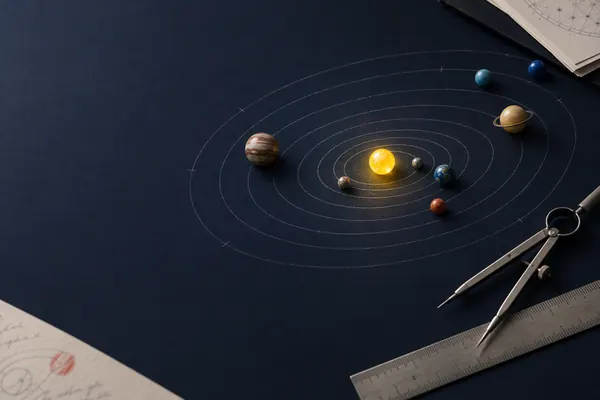
- First law: the orbit of each planet is an ellipse with the Sun at one focus.
- Second law: the line joining a planet to the Sun sweeps out equal areas in equal times.
- Third law: the square of the orbital period is proportional to the cube of the average distance from the Sun, T² ∝ r³.
The laws apply to any object orbiting a much larger mass, such as the Moon and artificial satellites around the Earth, and not just planets around the Sun. Most orbits in the solar system are close to circular, so in A-level calculations we usually treat them as circles and use r as the radius of the orbit, measured from the centre of the central body. For a true ellipse the quantity that goes into the third law is the semi-major axis, but you are not asked to work with ellipses numerically.
The first two laws in detail
An ellipse has two foci. The Sun sits at one and the other is empty. A circle is the special case where the two foci coincide. The point of closest approach to the Sun is called perihelion and the furthest point is aphelion (for the Earth, use perigee and apogee).
The second law tells you that the planet moves fastest at perihelion and slowest at aphelion. The area swept out per second is the same everywhere on the orbit. At the closest and furthest points the velocity is at right angles to the line to the Sun, and the area swept per second is ½vr, so ½v₁r₁ = ½v₂r₂ and the speed is inversely proportional to the distance at those two points: v₁r₁ = v₂r₂. This is a consequence of angular momentum being conserved, because gravity acts along the line to the Sun and so exerts no turning effect about it.
Be careful with the wording. The second law is about area swept per unit time, not speed. Saying that a planet travels at a constant speed in its orbit is wrong for an elliptical orbit. In a circular orbit, though, the speed is constant, and both statements are consistent.
Deriving T² = (4π²/GM)r³
For a satellite of mass m in a circular orbit of radius r around a much larger mass M, the only force on the satellite is gravity. This force acts towards the centre of the orbit, so it is the centripetal force.
- Gravitational force on the satellite: F = GMm/r².
- Centripetal force needed for circular motion: F = mω²r.
- Set them equal: GMm/r² = mω²r.
- Cancel m and rearrange: ω² = GM/r³.
- Use ω = 2π/T: 4π²/T² = GM/r³.
- Rearrange to find the period: T² = (4π²/GM)r³.
T² = (4π²/GM)r³
- T = orbital period in s
- r = orbital radius (centre to centre) in m
- M = mass of the central body in kg
- G = 6.67 × 10⁻¹¹ N m² kg⁻²
The constant 4π²/GM is the same for every satellite of the same central body, which is Kepler's third law: T² ∝ r³.
Two features of this result matter. First, the mass of the satellite m has cancelled, so a heavy satellite and a light one at the same radius have the same period. Second, M is the mass of the body at the centre. A different central body gives a different constant. The derivation also shows the orbital speed. Setting GMm/r² = mv²/r gives:
v = √(GM/r)
- v = orbital speed in m s⁻¹
A smaller orbit means a faster satellite. Combined with v = 2πr/T, this gives the same result as the T² equation.
Graphs: T² against r³ and log-log plots
Because T² = (4π²/GM)r³, a graph of T² on the y-axis against r³ on the x-axis is a straight line through the origin. The gradient is 4π²/GM, so once you have measured the gradient you can find the mass of the central body: M = 4π²/(G × gradient).
Sometimes the data span a very large range, for example the planets of the solar system, and a logarithmic plot is better. Take logarithms of both sides of T² = kr³ where k = 4π²/GM: 2 lg T = lg k + 3 lg r, so lg T = (3/2) lg r + ½ lg k. A graph of lg T against lg r is therefore a straight line with gradient 3/2 and an intercept on the vertical axis of ½ lg(4π²/GM). If your data do not give a gradient close to 1.5, something is wrong with your data or your units. Checking the gradient is a good way to test whether a set of results obeys Kepler's third law.
Two practical points apply. Use a consistent set of units for T and r, as the intercept depends on the units chosen (SI units are safest). Also remember that the logarithm of a quantity with units is not strictly defined, so axis labels are written as lg (T / s) and lg (r / m).
Geostationary orbits
A geostationary satellite stays above the same point on the Earth's surface. To do this it must satisfy four conditions.
- Its period must equal the Earth's rotation period, about 24 hours.
- It must orbit in the same direction as the Earth rotates (west to east).
- It must orbit directly above the equator. Only then does it stay over one point; an inclined orbit would make the satellite drift north and south and trace a figure of eight on the ground.
- It must have a particular radius, found using the third law.
To find the radius, rearrange T² = (4π²/GM)r³ to r³ = GMT²/4π². With T = 24 h = 8.64 × 10⁴ s, the radius comes out at about 4.22 × 10⁷ m measured from the Earth's centre. The height above the surface is that minus the Earth's radius, about 3.6 × 10⁷ m. The worked examples show the full calculation. Using the true rotation period of the Earth relative to the stars, slightly under 24 hours, changes the answer by less than 0.2%, which does not affect the answer at the precision of A-level data.
Geostationary satellites are used for communications and TV broadcasting, because a fixed dish can point at them without tracking. They are also used for some weather monitoring. Their disadvantages are the long signal delay because of the distance, and poor coverage near the poles, where the satellite is low on the horizon. Satellites in lower, faster orbits, including polar orbits that pass over the poles, are used for mapping and Earth observation, because they pass over the whole surface of the Earth as it rotates beneath them.
Satellite speed and energy
In a circular orbit, v² = GM/r, so the kinetic energy is Ek = ½mv² = GMm/2r. The potential energy is Ep = −GMm/r. The total energy is therefore:
E = Ek + Ep = GMm/2r − GMm/r = −GMm/2r
- E = total orbital energy in J
The total energy is negative, which means the satellite is bound. It is equal in size to the kinetic energy, and half the potential energy.
The three results to remember are Ek = −E, Ep = 2E and E = −GMm/2r. These come up often in short questions: for example, if a satellite is moved to a higher orbit, the total energy goes up (becomes less negative), the potential energy goes up, and the kinetic energy and speed go down. A satellite in a higher orbit moves more slowly and takes longer to go round.
There is a classic paradox. A satellite in a low orbit that loses energy to air resistance drops into a lower orbit, where it moves faster. The potential energy falls twice as much as the total energy, and the difference ends up as extra kinetic energy. This is why the speed increases as the orbit decays, even though the satellite is losing total energy.
Using orbital data to find the mass of a planet or star
Rearranging the third law gives the mass of the central body from the period and radius of anything orbiting it:
M = 4π²r³/(GT²)
Use SI units: r in metres and T in seconds.
This is how we find the mass of the Sun from the Earth's orbit, or the mass of a planet from the orbit of one of its moons. Notice that it gives the mass of the body being orbited, not of the orbiting satellite, whose mass cancels in the derivation. To find the mass of a planet with no moons, a space probe has to fly by it and be tracked, but that is beyond this topic. You may be given tables of orbital radii and periods and asked to use a graph, so be fluent with the straight-line forms in the graphs section.
Worked examples
Radius of a geostationary orbit
Calculate the radius of a geostationary orbit around the Earth, and the height of the satellite above the surface. Use M = 5.97 × 10²⁴ kg, R = 6.37 × 10⁶ m and a period of 24 hours.
- T = 24 × 60 × 60 = 8.64 × 10⁴ s (1 mark).
- r³ = GMT²/4π² (1 mark).
- GM = 6.67 × 10⁻¹¹ × 5.97 × 10²⁴ = 3.982 × 10¹⁴ and T² = 7.465 × 10⁹, so GMT² = 2.972 × 10²⁴ (1 mark).
- r³ = 2.972 × 10²⁴ ÷ 39.48 = 7.529 × 10²² m³, so r = 4.22 × 10⁷ m (1 mark).
- h = r − R = 4.22 × 10⁷ − 6.37 × 10⁶ = 3.59 × 10⁷ m (1 mark).
Answer r = 4.2 × 10⁷ m and h = 3.6 × 10⁷ m. The speed of the satellite is v = 2πr/T = 3.07 × 10³ m s⁻¹, about 3.1 km s⁻¹.
Low Earth orbit
A satellite orbits 4.0 × 10⁵ m above the Earth's surface. Calculate its orbital speed and its period. Use M = 5.97 × 10²⁴ kg and R = 6.37 × 10⁶ m.
- r = 6.37 × 10⁶ + 4.0 × 10⁵ = 6.77 × 10⁶ m (1 mark).
- v = √(GM/r) = √(3.982 × 10¹⁴ ÷ 6.77 × 10⁶) = √(5.882 × 10⁷) (1 mark).
- v = 7.67 × 10³ m s⁻¹ (1 mark).
- T = 2πr/v = 2π × 6.77 × 10⁶ ÷ 7.669 × 10³ = 5.55 × 10³ s (1 mark).
- This is 92.4 minutes, about 1.5 hours (1 mark for converting or checking against the T² formula).
Answer v = 7.7 × 10³ m s⁻¹ and T = 5.5 × 10³ s, about 92 minutes.
Mass of Mars from the orbit of a moon
A small moon of Mars orbits at a radius of 9.38 × 10⁶ m with a period of 7.65 hours. Calculate the mass of Mars.
- T = 7.65 × 3600 = 2.754 × 10⁴ s (1 mark).
- M = 4π²r³/(GT²) (1 mark).
- r³ = (9.38 × 10⁶)³ = 8.253 × 10²⁰ m³ and T² = 7.585 × 10⁸ s² (1 mark).
- M = 39.48 × 8.253 × 10²⁰ ÷ (6.67 × 10⁻¹¹ × 7.585 × 10⁸) = 3.258 × 10²² ÷ 5.059 × 10⁻² = 6.44 × 10²³ kg (1 mark).
Answer M = 6.4 × 10²³ kg.
Using a log-log graph
A student studies satellites of the Earth and plots lg (T / s) against lg (r / m). The line has a gradient of 1.5 and an intercept on the vertical axis of −6.50. (a) Explain why the gradient is 1.5. (b) Use the intercept to find the mass of the Earth.
- (a) T² = (4π²/GM)r³, so lg T = 1.5 lg r + ½ lg(4π²/GM). The power of r in T² ∝ r³ is 3, and halving gives 1.5 (2 marks).
- (b) The intercept is ½ lg(4π²/GM) = −6.50, so lg(4π²/GM) = −13.00 (1 mark).
- 4π²/GM = 10⁻¹³ (1 mark).
- M = 4π² ÷ (G × 10⁻¹³) = 39.48 ÷ (6.67 × 10⁻¹¹ × 10⁻¹³) = 5.92 × 10²⁴ kg (1 mark).
Answer (a) T² ∝ r³ gives a gradient of 3/2. (b) M = 5.9 × 10²⁴ kg.
Common mistakes
- Using the height above the surface as r. In the orbit equations r is measured from the centre of the planet.
- Forgetting that the mass in GM is the central body. The mass of the satellite cancels and never appears in T or v.
- Using days or hours in T² = 4π²r³/GM. Use seconds. The constant 4π²/GM depends on SI units.
- Saying a geostationary satellite stays still. It orbits with the same angular speed as the Earth turns. Remember the period, direction and equatorial plane.
- Stating that a satellite speeds up when it moves to a higher orbit. It slows down: v = √(GM/r), so v falls as r rises.
- Muddling total energy with potential energy. The total orbital energy is −GMm/2r and the potential energy is −GMm/r.
- Writing the second law as constant speed. It is constant area per unit time.
- Taking the gradient of a log-log graph as 3 or 2. For lg T against lg r, it is 3/2.
How OCR A examines Kepler's laws and orbits
Orbits are one of the best places to combine ideas from across Module 5, and the module hub at Module 5 shows how they fit together. Questions are often long, multi-step contexts about a named satellite or planet.
- Statements: stating Kepler's three laws, and defining a geostationary orbit.
- Derivation: showing that T² ∝ r³ from Newton's law of gravitation and the centripetal force. This is a standard question and worth practising until it is automatic.
- Calculations: geostationary radius, orbital speed, period, energy changes between orbits, and the mass of the central body from orbital data.
- Graphs: finding the gradient of T² against r³ or the gradient and intercept of a log-log graph, and using it to determine M. Practice with data tables helps.
- Synoptic links: gravitational fields for potential and field strength, circular motion for centripetal force, and simple harmonic motion for angular frequency. The astrophysics topics, such as Hubble's law and redshift, also use gravitational ideas on a larger scale.
Practice questions
A planet orbits a star at a radius four times that of a second planet orbiting the same star. Calculate the ratio of their periods, T₂ : T₁.2 marks
Show the answer
Answer: The more distant planet has a period 8 times longer.
T² ∝ r³, so T ∝ r^(3/2). T₂/T₁ = 4^(3/2) = 8.0.
The Earth orbits the Sun at an average radius of 1.50 × 10¹¹ m with a period of 3.156 × 10⁷ s. Calculate the mass of the Sun.4 marks
Show the answer
Answer: M = 2.0 × 10³⁰ kg
M = 4π²r³/(GT²) = 39.48 × (1.50 × 10¹¹)³ ÷ (6.67 × 10⁻¹¹ × (3.156 × 10⁷)²) = 39.48 × 3.375 × 10³³ ÷ (6.67 × 10⁻¹¹ × 9.960 × 10¹⁴) = 1.3325 × 10³⁵ ÷ 6.643 × 10⁴ = 2.006 × 10³⁰ kg.
A satellite of mass 800 kg orbits the Earth at radius 7.0 × 10⁶ m. Calculate its orbital speed and its total energy. Use M = 5.97 × 10²⁴ kg.5 marks
Show the answer
Answer: v = 7.5 × 10³ m s⁻¹, E = −2.3 × 10¹⁰ J
v = √(GM/r) = √(3.982 × 10¹⁴ ÷ 7.0 × 10⁶) = √(5.689 × 10⁷) = 7.54 × 10³ m s⁻¹. E = −GMm/2r = −(3.982 × 10¹⁴ × 800) ÷ (2 × 7.0 × 10⁶) = −2.28 × 10¹⁰ J.
A 500 kg satellite is moved from an orbit of radius 6.77 × 10⁶ m to a geostationary orbit of radius 4.22 × 10⁷ m. Calculate the change in its total energy. Use M = 5.97 × 10²⁴ kg.4 marks
Show the answer
Answer: Increase of 1.2 × 10¹⁰ J
E = −GMm/2r, so ΔE = (GMm/2)(1/r₁ − 1/r₂) = (3.982 × 10¹⁴ × 500 ÷ 2)(1/6.77 × 10⁶ − 1/4.22 × 10⁷) = 9.955 × 10¹⁶ × (1.4771 × 10⁻⁷ − 2.370 × 10⁻⁸) = 1.23 × 10¹⁰ J.
A comet moves at 3.0 × 10⁴ m s⁻¹ when it is 1.5 × 10¹¹ m from the Sun, at its closest approach. Calculate its speed at its furthest point, 4.5 × 10¹² m from the Sun.3 marks
Show the answer
Answer: v = 1.0 × 10³ m s⁻¹
At the two extreme points the velocity is perpendicular to the radius, so v₁r₁ = v₂r₂. v₂ = 3.0 × 10⁴ × 1.5 × 10¹¹ ÷ 4.5 × 10¹² = 1.0 × 10³ m s⁻¹.
Explain why a geostationary satellite must orbit above the equator and not above London.3 marks
Show the answer
Answer: The centre of the orbit must be the centre of the Earth, because gravity acts towards it. An orbit over London would be in a tilted plane that crosses the equator, so the satellite would move north and south of the equator in each orbit and could not stay above a single point on the surface. Only an equatorial orbit keeps the satellite over one point as the Earth rotates.
Marks for: the orbit plane contains the Earth's centre, a non-equatorial orbit moves north-south relative to the ground, only an equatorial orbit stays above one point.
Next steps
The derivation above relies on circular motion and on the field and potential ideas in gravitational fields, so revisit those if any step felt shaky. Simple harmonic motion is the other main idea in this part of the course. You can find every Module 5 topic on the module hub, and practise this topic with step-by-step marking, free to start.
Frequently asked questions
How do you derive Kepler's third law?
Gravity provides the centripetal force for a circular orbit, so GMm/r² = mω²r. Put ω = 2π/T and cancel m to get T² = (4π²/GM)r³. This shows T² is proportional to r³ for all bodies orbiting the same mass M.
What are the conditions for a geostationary orbit?
The orbit must have a period of 24 hours, be directly above the equator, and travel in the same direction as the Earth's rotation. The radius that gives this period is about 4.2 × 10⁷ m from the centre of the Earth, which is about 3.6 × 10⁷ m above the surface.
Why does a satellite go faster in a lower orbit?
The orbital speed is v = √(GM/r), so it increases as r decreases. A lower orbit has a stronger gravitational field, which needs a greater centripetal force and so a higher speed. The period is also shorter.
How do you find the mass of a planet from a moon's orbit?
Measure the orbital radius and period of the moon, then use M = 4π²r³/(GT²) with SI units. You can also plot T² against r³ for several moons and use the gradient, which is 4π²/GM.
What does the gradient of a log-log graph of T against r tell you?
For lg T against lg r the gradient is 3/2, which confirms T² ∝ r³. The intercept on the vertical axis is ½ lg(4π²/GM), which gives the mass of the central body.
Related guides




Written for the OCR A Level Physics A (H556) specification. Questions are original and written in exam style; they are not taken from OCR papers. Spotted a mistake? Tell us.