Key points
- Circular motion at constant speed is still accelerating, because the velocity changes direction.
- The centripetal acceleration is a = v²/r = ω²r and points towards the centre of the circle.
- The centripetal force F = mv²/r = mω²r is not a new force: it is the resultant of the real forces, such as tension, friction or gravity.
- Angular velocity ω = 2π/T = 2πf is measured in rad s⁻¹ and links to speed by v = ωr.
- The centripetal force acts at right angles to the motion, so it does no work and the speed stays constant.
- At the top of a vertical circle the minimum speed is v = √(gr), when the tension or contact force falls to zero.
Why circular motion needs a force
An object moving in a circle at constant speed is accelerating. Speed is a scalar, but velocity is a vector, and the direction of the velocity changes continuously as the object goes round. A change in velocity means acceleration, and by Newton's second law an acceleration needs a resultant force. For circular motion, that resultant force is called the centripetal force and it always points towards the centre of the circle.
This is the most important idea in the topic, and it is where many students go wrong. The centripetal force is not an extra force that you add to a diagram. It is the name for the resultant of whatever real forces act towards the centre. For a car on a bend it is friction. For a stone on a string it is tension. For the Moon it is the Earth's gravity. If you draw the centripetal force on a free-body diagram as well as the real forces, you are counting it twice.
Because the force is at right angles to the velocity at every instant, it does no work (work = force × distance moved in the direction of the force, and here that distance is zero). That is why the speed stays the same: the force changes the direction of the motion, not its size.
Radians, angular velocity and linear speed
In circular motion we measure angles in radians. One radian is the angle at the centre of a circle when the arc length equals the radius. In general θ = s/r, where s is the arc length and r is the radius. A full circle has an arc length of 2πr, so it is 2π radians. This means 360° = 2π rad, 180° = π rad and 1 rad = 57.3°. To convert degrees to radians, multiply by π/180.
The angular velocity ω is the angle swept out per second. For one complete revolution the angle is 2π rad and the time is the period T, so:
ω = Δθ/Δt = 2π/T = 2πf
- ω = angular velocity in rad s⁻¹
- T = period in s
- f = frequency in Hz (revolutions per second)
Revolutions per minute (rpm) must be converted: 60 rpm is 1 Hz, so ω = 2π × (rpm/60).
The linear speed is the distance travelled per second. In one period the object travels the circumference 2πr, so v = 2πr/T. Replacing 2π/T with ω gives:
v = ωr
- v = speed along the circle in m s⁻¹
- r = radius in m
Points further from the centre move faster, even though all points on a rotating disc share the same ω.
A good way to remember the difference is to think of a roundabout. Everyone on it has the same ω because they all complete a turn in the same time. The person on the edge has a bigger v because they travel a longer path in that time.
Centripetal acceleration and force
For an object moving at speed v in a circle of radius r, the centripetal acceleration is directed towards the centre and has magnitude:
a = v²/r = ω²r
- a = centripetal acceleration in m s⁻²
Then Newton's second law, F = ma, gives the resultant force required:
F = mv²/r = mω²r
- F = centripetal force in N
- m = mass in kg
Use the form that matches the data you are given. If you have ω or T, use mω²r. If you have the speed, use mv²/r.
You can see where a = v²/r comes from with a short argument. In a small time Δt the object moves through a small angle Δθ = ωΔt. The velocity vector is rotated by the same angle, and for a small angle the change in velocity has size Δv ≈ vΔθ, directed towards the centre. The acceleration is Δv/Δt = vΔθ/Δt = vω. Substituting ω = v/r gives a = v²/r. You do not need to reproduce this for the exam, but it shows why the acceleration points inwards and why it grows with v².
Notice the dependence. Doubling the speed on a given bend means the required centripetal force goes up by a factor of four. Halving the radius doubles it. This is why tight bends taken too quickly are so dangerous: the force needed quickly exceeds what friction can supply.
What provides the centripetal force
The skill in this topic is identifying the real force or forces that provide the centripetal force in each situation, and then writing resultant force towards the centre = mv²/r.
| Situation | What provides the force towards the centre |
|---|---|
| Planet or satellite in orbit | Gravitational force from the star or planet |
| Car on a flat circular bend | Friction between the tyres and the road |
| Stone whirled on a string in a horizontal circle | Tension in the string (the horizontal component if the string is not horizontal) |
| Conical pendulum | Horizontal component of the tension |
| Car on a banked track at the design speed | Horizontal component of the normal reaction |
| Electron in a magnetic field | Magnetic force, from F = Bqv |
| Passenger on a fairground ride against the wall | The normal reaction from the wall |
The last example is worth a note. A passenger who feels thrown outwards is not experiencing an outward force. The passenger's body tends to carry on in a straight line (Newton's first law), and the car door or wall provides the inward force that makes them turn. A written answer that mentions a centrifugal force will usually lose the mark in an A-level exam.
Car on a bend and the banked track
On a flat bend, friction provides the centripetal force. There is a maximum frictional force Fmax between the tyres and the road, so there is a maximum speed for a given radius: Fmax = mv²/r gives vmax = √(Fmax r/m). Wet or icy roads reduce Fmax and so reduce the safe speed. Notice that the mass can be a red herring if friction is proportional to the weight: since Fmax = μmg, vmax = √(μgr) and the mass cancels.
On a banked track, tilted at an angle θ to the horizontal, the normal reaction N from the road is perpendicular to the surface and so has a horizontal component N sin θ pointing towards the centre of the bend. At one particular speed, this alone supplies the centripetal force and no friction is needed. The vertical forces balance, so N cos θ = mg. The horizontal component gives N sin θ = mv²/r. Dividing the two equations gives:
tan θ = v²/(rg) so v = √(rg tan θ)
The design speed of a banked bend. It does not depend on the mass of the vehicle.
Railway tracks, velodromes and motorway slip roads are banked for this reason. At speeds above the design speed, friction acts down the slope to add to the inward force. Below it, friction acts up the slope.
Circles in a vertical plane
In a vertical circle, the weight acts at a constant size and direction, but the direction relative to the centre changes. The tension (or normal reaction) must change as the object goes round, and so does the speed, because gravitational potential energy and kinetic energy are exchanged.
At the top of the circle, both the tension and the weight point towards the centre, so T + mg = mv²/r. The minimum speed at the top occurs when the tension has fallen to zero and gravity alone provides the centripetal force: mg = mv²/r, giving v = √(gr). If the speed were less than this, the string would go slack and the object would leave the circular path.
At the bottom, the tension points up (towards the centre) and the weight points down (away from it), so T − mg = mv²/r, which means T = mg + mv²/r. The tension is largest at the bottom, which is where a string is most likely to break. To link the speeds at the top and bottom, use energy conservation. Going from the top to the bottom the object falls a height 2r, so ½mv²bottom = ½mv²top + mg(2r), giving v²bottom = v²top + 4gr. If the minimum speed is used at the top, then v²bottom = gr + 4gr = 5gr, so the speed at the bottom must be at least √(5gr).
The same logic applies to a car going over the top of a hump-backed bridge, where the normal reaction N from the road plays the role of the tension: mg − N = mv²/r. The car loses contact with the road when N = 0, which happens at v = √(gr).
Worked examples
Car on a bend
A car of mass 1200 kg travels at 15 m s⁻¹ round a flat circular bend of radius 45 m. (a) Calculate the centripetal acceleration and the friction force needed. (b) The maximum frictional force between the tyres and the road is 7200 N. Calculate the maximum speed on this bend.
- (a) a = v²/r = 15² ÷ 45 = 225 ÷ 45 = 5.0 m s⁻² (1 mark).
- F = ma = 1200 × 5.0 = 6000 N (1 mark).
- (b) At the limit the friction force is the centripetal force: Fmax = mv²/r (1 mark).
- v² = Fmax r/m = 7200 × 45 ÷ 1200 = 270 m² s⁻² (1 mark).
- v = √270 = 16.4 m s⁻¹ (1 mark).
Answer (a) a = 5.0 m s⁻² and F = 6.0 × 10³ N, (b) vmax = 16 m s⁻¹ (about 59 km per hour).
Centrifuge
A centrifuge rotates at 3000 revolutions per minute. A sample is 0.12 m from the axis. Calculate the angular velocity, the speed of the sample, and its centripetal acceleration as a multiple of g.
- 3000 rpm = 3000 ÷ 60 = 50 revolutions per second, so f = 50 Hz (1 mark).
- ω = 2πf = 2π × 50 = 314.2 rad s⁻¹ (1 mark).
- v = ωr = 314.2 × 0.12 = 37.7 m s⁻¹ (1 mark).
- a = ω²r = 314.2² × 0.12 = 98 696 × 0.12 = 1.184 × 10⁴ m s⁻² (1 mark).
- a/g = 11 844 ÷ 9.81 = 1207, so about 1200 g (1 mark).
Answer ω = 314 rad s⁻¹, v = 38 m s⁻¹, a = 1.2 × 10⁴ m s⁻² which is about 1200 g.
Conical pendulum
A small bob of mass 0.050 kg hangs on a string of length 0.80 m and moves in a horizontal circle with the string at 30° to the vertical. Calculate (a) the radius of the circle, (b) the tension, (c) the speed of the bob and (d) the time for one revolution.
- (a) r = L sin θ = 0.80 × sin 30° = 0.40 m (1 mark).
- (b) Vertically T cos θ = mg, so T = 0.050 × 9.81 ÷ cos 30° = 0.4905 ÷ 0.8660 = 0.566 N (2 marks).
- (c) Horizontally T sin θ = mv²/r, which with the vertical equation gives tan θ = v²/(rg) (1 mark).
- v² = rg tan θ = 0.40 × 9.81 × 0.5774 = 2.266, so v = 1.51 m s⁻¹ (1 mark).
- (d) Time for one revolution = 2πr/v = 2π × 0.40 ÷ 1.505 = 1.67 s (2 marks).
Answer (a) 0.40 m, (b) 0.57 N, (c) 1.5 m s⁻¹, (d) 1.7 s.
Vertical circle
A ball of mass 0.50 kg is whirled on a string in a vertical circle of radius 0.60 m. (a) Calculate the minimum speed at the top of the circle. (b) Calculate the speed at the bottom if the ball has this minimum speed at the top. (c) Calculate the tension in the string at the bottom for this case.
- (a) At minimum speed T = 0 at the top, so mg = mv²/r (1 mark).
- v = √(gr) = √(9.81 × 0.60) = √5.886 = 2.43 m s⁻¹ (1 mark).
- (b) Energy conservation: ½mv²bottom = ½mv²top + mg(2r) (1 mark).
- v²bottom = 5.886 + 4 × 9.81 × 0.60 = 5.886 + 23.544 = 29.43, so v = 5.42 m s⁻¹ (1 mark).
- (c) At the bottom T − mg = mv²/r, so T = mg + mv²/r (1 mark).
- T = 0.50 × 9.81 + 0.50 × 29.43 ÷ 0.60 = 4.905 + 24.525 = 29.4 N, which is 6mg (1 mark).
Answer (a) 2.4 m s⁻¹, (b) 5.4 m s⁻¹, (c) 29 N, six times the weight of the ball.
Common mistakes
- Adding a centripetal force to the free-body diagram. It is the resultant of the real forces, not an extra one. Label the real forces (tension, friction, weight, normal reaction) and state which combination points to the centre.
- Writing about centrifugal force. There is no outward force on the object. It tends to move in a straight line, as Newton's first law says.
- Saying the acceleration is zero because the speed is constant. The velocity changes direction, so the acceleration is not zero.
- Using degrees in θ = s/r or v = ωr. Angles in these equations must be radians.
- Forgetting to convert rpm. Divide by 60 to get Hz, then multiply by 2π for rad s⁻¹.
- Mixing r and diameter. Check whether a question gives the diameter of a wheel or track.
- Using the string length as r in a conical pendulum. The radius of the circle is L sin θ.
- Assuming the tension is the same all the way round a vertical circle. It changes with position and is greatest at the bottom.
How OCR A examines circular motion
Circular motion is in Module 5 and is often tested with calculations followed by an explanation. Start from the module hub to see how it fits with thermal physics, oscillations, gravitation and astrophysics.
- Short calculations: converting between T, f and ω, finding v from ω and r, and finding F or a.
- Free-body diagrams: usually for a car on a bend, a conical pendulum, a banked track or a vertical circle, followed by an equation for the resultant force towards the centre.
- Explanations: why a body moving at constant speed in a circle is accelerating, why no work is done, and which force provides the centripetal force.
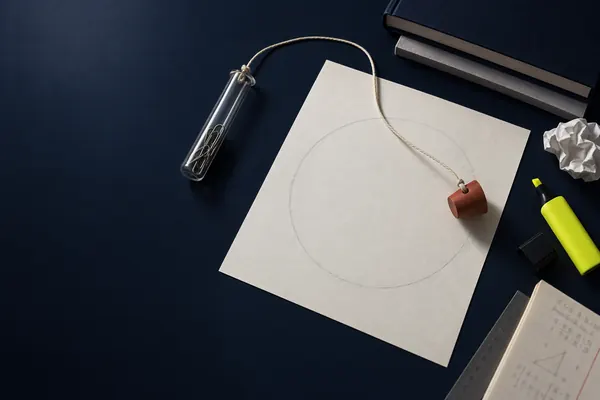
- Practical work: whirling a bung on a string with a weight hanging from the bottom, then measuring the period for different radii or forces, is a classic investigation that fits the practical skills expectations. Be ready to plot F against ω² or against 1/r and discuss uncertainty.
- Synoptic links: simple harmonic motion uses the same ω, and gravitational fields and Kepler's third law use F = mv²/r with gravity as the centripetal force. Charged particles in magnetic fields (see magnetic fields) follow circular paths for the same reason.
Practice questions
A wheel of radius 0.25 m rotates at 120 revolutions per minute. Calculate the angular velocity, the speed of a point on the rim and the centripetal acceleration of that point.4 marks
Show the answer
Answer: ω = 12.6 rad s⁻¹, v = 3.1 m s⁻¹, a = 39 m s⁻²
120 rpm = 2.0 Hz. ω = 2π × 2.0 = 12.57 rad s⁻¹. v = ωr = 12.57 × 0.25 = 3.14 m s⁻¹. a = ω²r = 157.9 × 0.25 = 39.5 m s⁻².
A person stands on the Equator. The radius of the Earth is 6.37 × 10⁶ m and it rotates once in 8.62 × 10⁴ s. Calculate the person's speed and centripetal acceleration due to the rotation of the Earth.4 marks
Show the answer
Answer: v = 464 m s⁻¹, a = 0.034 m s⁻²
ω = 2π/T = 2π ÷ 8.62 × 10⁴ = 7.29 × 10⁻⁵ rad s⁻¹. v = ωr = 7.289 × 10⁻⁵ × 6.37 × 10⁶ = 464 m s⁻¹. a = ω²r = (7.289 × 10⁻⁵)² × 6.37 × 10⁶ = 0.0338 m s⁻².
An athlete swings a 2.5 kg mass in a horizontal circle of radius 1.2 m, completing one revolution every 0.60 s. Calculate the tension needed in the wire, assuming it is horizontal.4 marks
Show the answer
Answer: F = 330 N
ω = 2π/0.60 = 10.47 rad s⁻¹. F = mω²r = 2.5 × 10.47² × 1.2 = 2.5 × 109.7 × 1.2 = 329 N, so 330 N to 2 s.f.
A banked bend has radius 120 m and is banked at 12° to the horizontal. Calculate the speed at which a vehicle needs no sideways friction.3 marks
Show the answer
Answer: v = 16 m s⁻¹
tan θ = v²/(rg), so v² = 120 × 9.81 × tan 12° = 1177.2 × 0.2126 = 250.2. v = 15.8 m s⁻¹.
A car of mass 900 kg crosses the top of a hump in the road of radius 40 m at 12 m s⁻¹. Calculate the normal reaction force from the road. Calculate the speed at which the car would just leave the road.5 marks
Show the answer
Answer: N = 5.6 × 10³ N, vmax = 20 m s⁻¹
At the top, mg − N = mv²/r. N = 900 × 9.81 − 900 × 12² ÷ 40 = 8829 − 3240 = 5589 N. The car leaves the road when N = 0, so v = √(gr) = √(9.81 × 40) = 19.8 m s⁻¹.
A passenger in a car turning left says they were thrown to the right. Explain, in terms of Newton's laws, what really happens.3 marks
Show the answer
Answer: The passenger's body tends to continue in a straight line (Newton's first law). The car turns left, so the passenger moves relative to the car towards the right. The door or seat belt then provides a resultant force towards the centre of the turn (to the left), which makes the passenger follow the circular path. There is no outward force.
Marks for: tends to continue in a straight line, a resultant force towards the centre is needed to turn, and that force is provided by the door or seat. Do not use the term centrifugal force.
Next steps
Now that you know how a force towards the centre produces circular motion, see it in action in gravitational fields and in the Kepler's third law derivation, where gravity is the centripetal force on a satellite. The same angular frequency appears in simple harmonic motion. Find all the Module 5 topics on the module hub, and practise this topic with step-by-step marking, free to start.
Frequently asked questions
Why is there an acceleration if the speed is constant in circular motion?
Acceleration is the rate of change of velocity, and velocity includes direction. In circular motion the direction changes all the time, so the velocity changes and there is an acceleration. It points towards the centre of the circle and has magnitude v²/r.
Is centripetal force a real force?
It is not a separate type of force. Centripetal force is the name for the resultant force towards the centre of the circle. It is provided by real forces such as tension, friction, gravity or a normal reaction.
What is the difference between centripetal and centrifugal force?
Centripetal force acts towards the centre and is the real resultant force that keeps an object on a circular path. Centrifugal force is the apparent outward force felt in a rotating frame, and it is not a real force in the frame used for A-level Physics. Do not use it in exam answers.
How do you convert revolutions per minute to radians per second?
Divide by 60 to get revolutions per second (hertz), then multiply by 2π. For example, 3000 rpm is 50 Hz, so ω = 2π × 50 = 314 rad s⁻¹.
What is the minimum speed at the top of a vertical circle?
The minimum speed at the top is v = √(gr), when the tension or contact force falls to zero and the weight alone supplies the centripetal force. For a ball on a string, any slower and the string would go slack.
Related guides



Written for the OCR A Level Physics A (H556) specification. Questions are original and written in exam style; they are not taken from OCR papers. Spotted a mistake? Tell us.