Key points
- E = mcΔθ gives the energy to change temperature; c is measured in J kg⁻¹ K⁻¹.
- E = mL gives the energy to change state at constant temperature; L is measured in J kg⁻¹.
- Internal energy is the sum of the random kinetic and potential energies of all the particles.
- On a heating curve, the plateaus are changes of state: potential energy rises while kinetic energy stays the same.
- Temperature in kelvin is the Celsius value plus 273, and 0 K is absolute zero.
What specific heat capacity and specific latent heat mean
When you heat something, one of two things happens. Either its temperature rises, or it changes state and the temperature stays put. Specific heat capacity describes the first case. Specific latent heat describes the second. Together they are the two ideas behind almost every thermal energy calculation in A-level Physics.
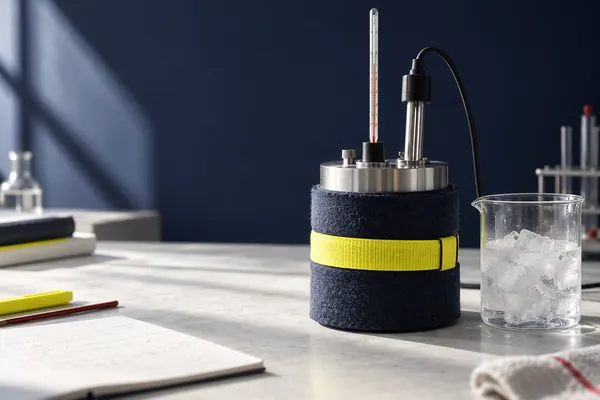
The specific heat capacity, c, of a substance is the energy required to raise the temperature of 1 kg of the substance by 1 K (or 1 °C) without a change of state. Water has a large value, about 4180 J kg⁻¹ K⁻¹, which is why it takes a long time to heat up and a long time to cool down. Metals have much smaller values, so they warm up quickly.
The specific latent heat of fusion, Lf, is the energy required to change 1 kg of solid to liquid at its melting point without a change of temperature. The specific latent heat of vaporisation, Lv, is the energy required to change 1 kg of liquid to gas at its boiling point without a change of temperature. For water, Lf is about 3.34 × 10⁵ J kg⁻¹ and Lv is about 2.26 × 10⁶ J kg⁻¹. Boiling takes roughly seven times more energy per kilogram than melting, and the kinetic model below explains why.
The kinetic model and internal energy
Every substance is made of particles that are always moving and that attract each other. The internal energy of a body is the sum of the randomly distributed kinetic energies and potential energies of all its particles. The kinetic part comes from the particles moving (vibrating in a solid, moving about in a liquid or gas). The potential part comes from the forces between the particles.
Temperature is linked only to the kinetic part. For an ideal gas the average kinetic energy of a particle is proportional to the thermodynamic temperature, and the same idea carries over to solids and liquids: hotter means the particles have more kinetic energy on average. The ideal gas equation guide shows the exact relationship.
- Heating without a change of state: the energy supplied increases the mean kinetic energy of the particles, so the temperature rises. The potential energy changes only slightly.
- Heating during a change of state: the energy supplied is used to pull particles apart against the attractive forces, so the potential energy rises. The mean kinetic energy does not change, so the temperature stays constant.
- Cooling: the same ideas run in reverse. The substance gives out energy, either by the temperature falling or, at a freezing or condensing point, by the potential energy falling.
Turning a liquid into a gas needs far more energy than turning a solid into a liquid because the particles must be separated completely, not just loosened. Also, the vapour has to push back the atmosphere as it expands, which takes some extra energy. That is why Lv is much larger than Lf.
The equations and their units
E = mcΔθ
- E = energy transferred to or from the substance / J
- m = mass / kg
- c = specific heat capacity / J kg⁻¹ K⁻¹
- Δθ = change in temperature / K (or °C)
Valid only while the substance stays in one state. A change of 1 K is the same size as a change of 1 °C.
E = mL
- E = energy transferred during the change of state / J
- m = mass that changes state / kg
- L = specific latent heat (fusion or vaporisation) / J kg⁻¹
There is no temperature change in this equation. If a question gives both a change of state and a temperature change, use both equations and add the energies.
If a heater of power P switches on for a time t, the electrical energy supplied is E = Pt. For a heater run from a supply, E = VIt. You will use this link constantly, because most thermal questions involve a heater or a kettle.
| Substance | c / J kg⁻¹ K⁻¹ | Process | L / J kg⁻¹ |
|---|---|---|---|
| Water | 4180 | Ice melting (Lf) | 3.34 × 10⁵ |
| Ice | 2100 | Water boiling (Lv) | 2.26 × 10⁶ |
| Steam | 2000 (approx.) | ||
| Aluminium | 900 (approx.) | ||
| Copper | 385 (approx.) |
Heating curves and what the plateaus show
A heating curve plots temperature against time for a substance heated at a constant power. Because the energy supplied is E = Pt, the horizontal axis is also a measure of the energy supplied. The graph below shows ice at −20 °C heated until it becomes steam.
Read the graph in three steps. First, find the plateaus: these are melting and boiling. Second, compare the gradients of the sloping sections: the gradient is Δθ/t = P/(mc), so a steeper line means a smaller specific heat capacity (for the same mass and power). Third, compare the lengths of the plateaus: the longer plateau needs more energy, so it has the larger specific latent heat.
On a cooling curve the picture is the same but reversed. The temperature falls, flattens while the substance freezes or condenses (it is giving out energy as its potential energy falls) and then falls again.
Electrical methods: finding c and L in the lab
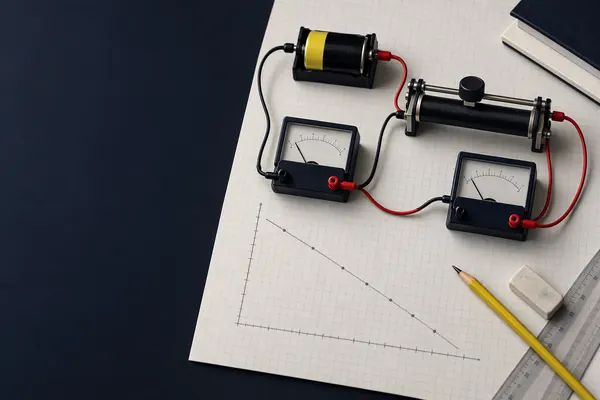
OCR A expects you to know how to measure specific heat capacity and specific latent heat using an electrical heater. These experiments sit within the practical endorsement (the practical activity groups, or PAGs), so you should be able to describe the method, the measurements, the calculation and the main sources of error. Your teacher will tell you which PAG covers the thermal experiments at your centre.
Sources of error and improvements. Energy is lost to the surroundings, so not all the electrical energy supplied is stored in the block. This makes the temperature rise smaller than it should be, and the calculated value of c too large. You reduce this by lagging the block, and by starting a few degrees below room temperature and finishing the same number above it, so that gains early on roughly cancel losses later. The thermometer may be slow to respond, and the temperature can keep rising after the heater is switched off as energy spreads through the block, so wait for the maximum reading. A small temperature rise gives a large percentage uncertainty in Δθ, so heat for long enough to get a rise of many degrees.
Specific latent heat of fusion. Put crushed ice in a funnel with the heater inside and collect the melt water in a beaker. Run the heater for a measured time and record the mass of water collected, m₁. Ice also melts from heat in the room, so repeat for the same time with the heater off and record the mass m₂. Then Pt = (m₁ − m₂)L, so L = Pt/(m₁ − m₂).
Specific latent heat of vaporisation. Boil water with the heater and weigh the water that is lost as steam. A neat trick is to run the experiment twice at different powers, P₁ and P₂, for the same time. The energy lost to the surroundings is about the same in both runs, so it cancels: (P₁ − P₂)t = (m₁ − m₂)L. Explain this cancelling idea clearly if you are asked how to improve the method.
The method of mixtures
You can also find a specific heat capacity without a heater. Heat a solid sample in boiling water so it is at about 100 °C, transfer it quickly to a calorimeter of cool water, stir and record the highest temperature. If no energy is lost to the surroundings, the energy lost by the hot object equals the energy gained by the cooler water (and calorimeter).
m₁c₁(θ₁ − θf) = m₂c₂(θf − θ₂)
- 1 = hot object, 2 = cold water
- θf = final common temperature / °C
Add a term mcal ccal (θf − θ₂) on the right if the calorimeter's heat capacity matters.
This method is simple but less accurate than the electrical method: the sample cools during the transfer, energy is lost while the mixture settles, and the temperature change of the water can be small. You can improve it by using a lagged calorimeter with a lid, stirring gently, and moving the sample quickly.
Absolute zero and the kelvin scale
The Celsius scale is built from two reference points of water, which is convenient but arbitrary. The thermodynamic (kelvin) scale is different. Absolute zero, 0 K, is the lowest possible temperature. It is the temperature at which the particles have the minimum possible internal energy, so no more energy can be removed. On the Celsius scale it is about −273 °C.
T / K = θ / °C + 273
A change of 1 K equals a change of 1 °C. Use 273 unless a question says 273.15. Gas laws and kinetic theory equations always need T in kelvin.
On the kelvin scale, temperature is proportional to the mean kinetic energy of the particles of an ideal gas, which is why it is the natural scale for physics. The ideal gas equation guide shows how extrapolating a pressure-temperature graph back to zero pressure gives absolute zero.
Worked examples
Heating water in a kettle
A kettle heats 0.50 kg of water from 20 °C to 100 °C. The specific heat capacity of water is 4180 J kg⁻¹ K⁻¹. (a) Calculate the energy transferred to the water. (b) The kettle has a power of 2.0 kW and is 85% efficient. Calculate the time taken.
- Δθ = 100 − 20 = 80 K
- E = mcΔθ = 0.50 × 4180 × 80 = 1.672 × 10⁵ J
- Useful power = 0.85 × 2000 = 1700 W
- t = E/P = 1.672 × 10⁵ / 1700 = 98.4 s
Answer (a) 1.7 × 10⁵ J (b) 98 s
Boiling water away
A heater of power 3.0 kW is used to boil water already at 100 °C. The specific latent heat of vaporisation of water is 2.26 × 10⁶ J kg⁻¹. Calculate the mass of water that is turned to steam in 150 s, assuming no energy is lost.
- Energy supplied E = Pt = 3000 × 150 = 4.5 × 10⁵ J
- E = mL, so m = E/L
- m = 4.5 × 10⁵ / 2.26 × 10⁶ = 0.199 kg
Answer 0.20 kg
Ice to water
Ice of mass 0.10 kg at 0 °C is heated until it becomes water at 20 °C. Lf = 3.34 × 10⁵ J kg⁻¹ and c(water) = 4180 J kg⁻¹ K⁻¹. (a) Calculate the total energy needed. (b) How long does a 100 W heater take, if all its energy is transferred to the ice and water?
- Melting: E₁ = mLf = 0.10 × 3.34 × 10⁵ = 3.34 × 10⁴ J
- Warming the water: E₂ = mcΔθ = 0.10 × 4180 × 20 = 8.36 × 10³ J
- Total E = 3.34 × 10⁴ + 8.36 × 10³ = 4.176 × 10⁴ J
- t = E/P = 4.176 × 10⁴ / 100 = 418 s
Answer (a) 4.2 × 10⁴ J (b) 4.2 × 10² s (about 7 minutes)
Specific heat capacity from an electrical experiment
A 0.80 kg metal block is heated by a 60 W heater for 8.0 minutes. Its temperature rises from 19.0 °C to 58.0 °C. Calculate the specific heat capacity of the metal and explain whether the true value is likely to be higher or lower.
- t = 8.0 × 60 = 480 s, so E = Pt = 60 × 480 = 2.88 × 10⁴ J
- Δθ = 58.0 − 19.0 = 39.0 K
- c = E/(mΔθ) = 2.88 × 10⁴ / (0.80 × 39.0) = 923 J kg⁻¹ K⁻¹
- Some energy is lost to the surroundings, so the energy that heated the block was less than 2.88 × 10⁴ J
Answer c = 9.2 × 10² J kg⁻¹ K⁻¹ (2 s.f.). The true value is likely to be lower, because the calculation assumes all the supplied energy stayed in the block.
Method of mixtures
A 0.15 kg metal sample at 100 °C is dropped into 0.20 kg of water at 18.0 °C. The final temperature is 24.0 °C. Ignoring the calorimeter and energy losses, calculate the specific heat capacity of the metal.
- Energy gained by water = 0.20 × 4180 × (24.0 − 18.0) = 5016 J
- Energy lost by metal = 0.15 × c × (100 − 24.0) = 0.15 × c × 76
- Set equal: 0.15 × 76 × c = 5016
- c = 5016 / 11.4 = 440 J kg⁻¹ K⁻¹
Answer c = 4.4 × 10² J kg⁻¹ K⁻¹
Common mistakes
How OCR A examines this topic
Expect a mix of short calculations, graph interpretation and practical explanations. Typical question styles are:
- A straightforward use of E = mcΔθ or E = mL, often with a heater power and time to calculate.
- Multi-stage energy calculations that join the two equations, sometimes with a graph of temperature against time.
- Describing or improving the electrical method, including why the result is too large and how a graph helps.
- Explaining on a particle level what happens to kinetic and potential energy during heating and at a change of state.
- Converting between °C and K, or explaining what absolute zero means.
The topic is also synoptic. The energy supplied by a heater links to power and electric circuits (resistance and resistivity and EMF and internal resistance), and the particle model links to the ideal gas equation. Practical-style questions on uncertainties, graph gradients and improvements to a method can appear in any paper. See the full list of topics on the Module 5 hub.
Practice questions
Convert 37 °C to kelvin and 250 K to degrees Celsius.2 marks
Show the answer
Answer: 310 K and −23 °C
T = 37 + 273 = 310 K. θ = 250 − 273 = −23 °C.
A 1.5 kg aluminium block (c = 900 J kg⁻¹ K⁻¹) is heated from 20 °C to 70 °C by a 2.0 kW heater with no energy loss. How long does this take?3 marks
Show the answer
Answer: 34 s
E = 1.5 × 900 × 50 = 6.75 × 10⁴ J. t = E/P = 6.75 × 10⁴ / 2000 = 33.75 s, so 34 s.
In an experiment to find the specific latent heat of fusion of ice, a 36 W heater runs for 600 s. The mass of water collected is 0.065 kg more than in a control run without the heater. Calculate Lf.3 marks
Show the answer
Answer: 3.3 × 10⁵ J kg⁻¹
E = Pt = 36 × 600 = 2.16 × 10⁴ J. L = E/m = 2.16 × 10⁴ / 0.065 = 3.32 × 10⁵ J kg⁻¹.
0.050 kg of steam at 100 °C condenses and the water cools to 60 °C. Calculate the energy released. (Lv = 2.26 × 10⁶ J kg⁻¹, c = 4180 J kg⁻¹ K⁻¹)3 marks
Show the answer
Answer: 1.2 × 10⁵ J
Condensing: 0.050 × 2.26 × 10⁶ = 1.13 × 10⁵ J. Cooling: 0.050 × 4180 × 40 = 8.36 × 10³ J. Total = 1.2136 × 10⁵ J.
Water boils at a constant 100 °C while a heater supplies energy. Explain in terms of particles why the temperature does not rise.3 marks
Show the answer
Answer: The energy supplied increases the potential energy of the particles as they are separated against the attractive forces. The mean kinetic energy of the particles does not change. Temperature depends on mean kinetic energy, so it stays constant.
Link: energy in, potential energy up, kinetic energy constant, so temperature constant.
Next steps
Once you are comfortable with energy and temperature, move on to the ideal gas equation, where the particle model gets mathematical. If you want to see energy exchange in a different setting, try simple harmonic motion. You can also practise this topic with step-by-step marking, which is free to start.
Frequently asked questions
What is the difference between specific heat capacity and specific latent heat?
Specific heat capacity is the energy needed per kilogram to raise the temperature by 1 K, with no change of state. Specific latent heat is the energy needed per kilogram to change state at constant temperature. One involves a temperature change and the other does not.
Why does the temperature stay constant when a substance melts or boils?
The energy supplied goes into increasing the potential energy of the particles as they are separated against attractive forces. The mean kinetic energy stays the same, and temperature depends on mean kinetic energy, so the temperature does not change.
Why is the latent heat of vaporisation bigger than the latent heat of fusion?
Melting only loosens the bonds between particles, but boiling separates them completely. The vapour also has to push back the atmosphere as it expands, which needs extra energy. So each kilogram needs more energy to boil than to melt.
Why is my experimental value of specific heat capacity too high?
Usually energy is lost to the surroundings, so the temperature rise is smaller than it should be for the energy supplied. Dividing the full electrical energy by this smaller rise gives a value of c that is too large. Better insulation and starting below room temperature help.
How do you convert Celsius to kelvin?
Add 273 to the temperature in degrees Celsius. A change of 1 °C is the same size as a change of 1 K, so temperature differences are the same on both scales.
Related guides
Written for the OCR A Level Physics A (H556) specification. Questions are original and written in exam style; they are not taken from OCR papers. Spotted a mistake? Tell us.