Key points
- Resistance is R = V/I, in ohms (Ω). It is the p.d. needed per unit current.
- Ohm's law: for an ohmic conductor at constant temperature, current is directly proportional to p.d.
- Resistivity is ρ = RA/L, in Ω m. It depends on the material and temperature, not the dimensions.
- Metals: resistance rises with temperature. NTC thermistors and LDRs: resistance falls as temperature or light level rises.
- P = VI = I²R = V²/R, and 1 kWh = 3.6 × 10⁶ J.
What resistance and resistivity mean
Resistance and resistivity are linked but different ideas, and mixing them up is one of the easiest ways to lose marks in Module 4. Resistance describes one particular component: this length of this wire at this temperature. Resistivity describes the material itself, so every piece of copper at the same temperature has the same resistivity whatever its size.
Resistance exists because charge carriers do not move freely through a conductor. In a metal the free electrons are repeatedly scattered by the vibrating lattice of positive ions, and they transfer energy to it. The larger the p.d. you apply, the faster the carriers drift on average, but the scattering means you have to keep doing work on them to maintain a current. That energy appears as heating of the conductor.
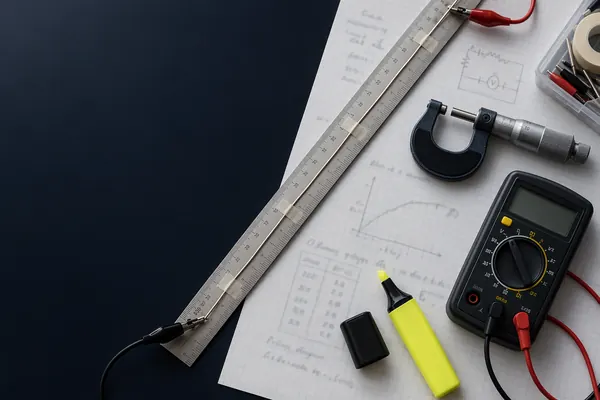
This guide covers the OCR A Module 4 content on resistance, I-V characteristics, resistivity, temperature effects and electrical power. It leads naturally into potential dividers and emf and internal resistance. The full topic list is on the Module 4 hub.
Equations and units
R = V / I
- R = resistance (Ω)
- V = potential difference across the component (V)
- I = current through the component (A)
One ohm is one volt per ampere. This defines resistance at any point on an I-V graph, whether or not the component is ohmic.
R = ρL / A
- ρ = resistivity of the material (Ω m)
- L = length of the conductor (m)
- A = cross-sectional area (m²)
Rearranged, ρ = RA / L. The unit is the ohm metre, not the ohm per metre.
P = VI = I²R = V²/R
- P = power (W)
- E = Pt, the energy transferred (J) in time t (s)
Choose the form that uses the quantities you were given. For the same resistor, P ∝ I² and P ∝ V².
Ohm's law is often quoted carelessly. The precise statement is that for an ohmic conductor at constant temperature, the current is directly proportional to the potential difference. A graph of I against V is then a straight line through the origin. Many components do not obey this, but R = V/I still works for them at any single point.
Unit conversions cause more lost marks than the physics. Convert diameters from millimetres to metres before you calculate an area, and remember that 1 mm² is 10⁻⁶ m², not 10⁻³ m². A wire with a diameter of 0.30 mm has a radius of 0.15 mm, which is 1.5 × 10⁻⁴ m.
I-V characteristics of common components
An I-V characteristic plots current on the vertical axis against p.d. on the horizontal axis. You need to recognise four shapes and explain each one in terms of what happens to the charge carriers.
| Component | Shape of I-V graph | What happens to resistance | Explanation |
|---|---|---|---|
| Fixed resistor (constant temperature) | Straight line through the origin, same in both directions | Constant | Ohmic: I is proportional to V |
| Filament lamp | S-shaped through the origin, gradient decreasing as |V| rises | Increases as V and I increase | The filament heats up, the lattice ions vibrate more, so electrons are scattered more often |
| Diode | Almost no current below about 0.6 V forward, then a steep rise. Almost no current in reverse | Very high in reverse and below threshold, low once conducting | One-way conduction with a threshold p.d. that depends on the material |
| LED | Like a diode but a higher threshold, often around 1.6 V to 2 V for red | Same pattern as a diode | Emits light when conducting; threshold depends on the colour |
Be careful with the lamp. Its resistance at a point is V/I at that point, so it rises as the lamp gets hotter. It is not the gradient of the curve. For a curve with I on the vertical axis, the gradient is dI/dV, which is the reciprocal of the resistance only for a straight line through the origin.
Resistance and temperature: metals, thermistors and LDRs
In a metal conductor, the number density of free electrons is essentially fixed. When the temperature rises, the lattice ions vibrate with larger amplitude, so electrons collide with them more frequently. Their average drift velocity for a given p.d. falls, so the current falls and R = V/I rises. This is the same explanation as for the filament lamp.
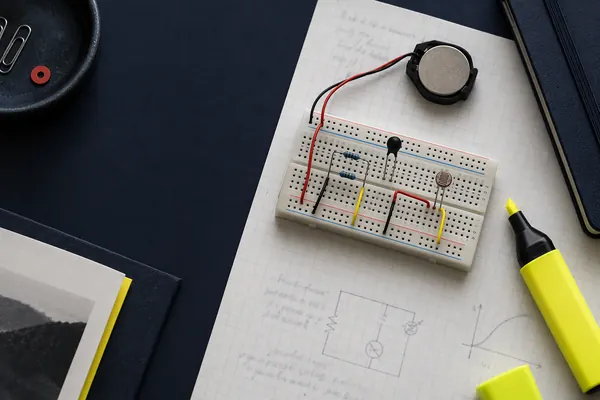
A negative temperature coefficient (NTC) thermistor is made from a semiconductor. Heating it releases more charge carriers, so the number density n increases a lot. Because I = nAvq, this outweighs the extra scattering and the resistance falls as temperature rises. A light-dependent resistor (LDR) behaves similarly with light: photons give energy to bound electrons, releasing more carriers, so its resistance falls as light intensity rises.
This is why thermistors and LDRs are the standard sensors in potential divider circuits. A change in temperature or light level changes the resistance, which changes the output voltage you can measure or use to switch something on.
- Metal: more lattice vibration, same number of carriers, so R increases with temperature.
- NTC thermistor: many more carriers at higher temperature, so R decreases.
- LDR: more carriers released at higher light intensity, so R decreases.
Resistivity: why R = ρL/A
For a uniform conductor, doubling the length doubles the resistance because the carriers must pass through twice as many scattering sites in series. Doubling the cross-sectional area halves the resistance because there are two identical paths in parallel. Combining these gives R ∝ L/A, and the constant of proportionality is the resistivity ρ.
| Material | Resistivity ρ / Ω m | Typical use |
|---|---|---|
| Copper | 1.7 × 10⁻⁸ | Wiring and cables |
| Constantan | 4.9 × 10⁻⁷ | Resistance wire used in practicals, because ρ changes little with temperature |
Notice that constantan has a resistivity about 30 times greater than copper. That is why a metre of thin constantan wire gives a convenient resistance of a few ohms, while the same length of copper wire of the same thickness has almost none.
Because the area depends on the diameter squared, a small error in measuring the diameter becomes a bigger percentage error in A. If the diameter has a 3% uncertainty, the area has about 6%. This is why the micrometer measurement is the main source of uncertainty in the resistivity experiment.
Practical: determining the resistivity of a wire
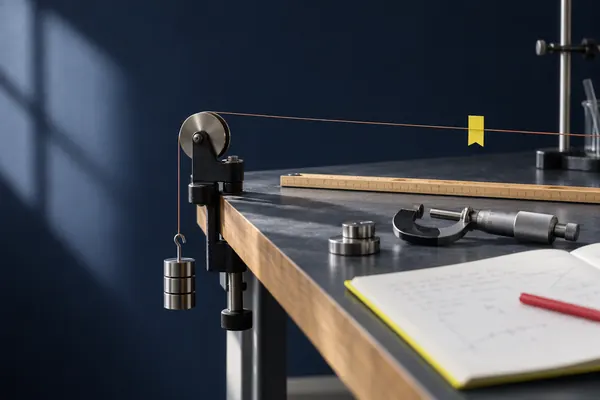
OCR's practical activity groups include determining the resistivity of a metal wire. The method below is the standard approach and the one examiners expect you to be able to describe and evaluate.
- Measure the diameter d of the wire with a micrometer at several points along its length and in two perpendicular directions at each point. Check for zero error first. Calculate the mean and use A = πd²/4.
- Fix the wire taut along a metre rule. Connect one lead to a crocodile clip at the 0 end and attach a second clip to a sliding contact.
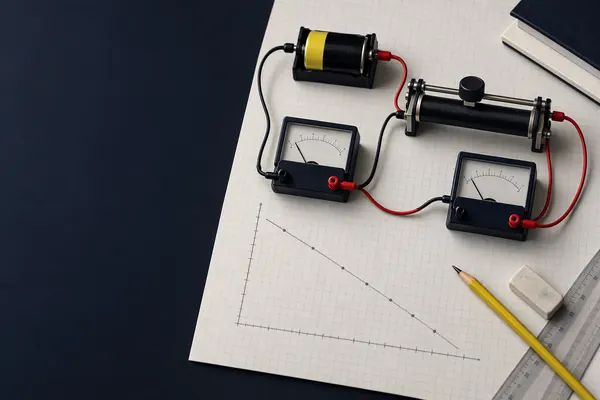
- Measure the current with an ammeter in series and the p.d. across the length L with a voltmeter in parallel, or measure R directly with an ohmmeter.
- Record R = V/I for at least six lengths L, switching off between readings so the wire does not heat up.
- Plot R (vertical) against L (horizontal). The graph should be a straight line through the origin.
- The gradient is ρ/A, so ρ = gradient × A.
Electrical power and the kilowatt-hour
Power is the rate of energy transfer. When charge Q moves through a p.d. V, the energy transferred is W = QV. Dividing by time gives P = (Q/t)V = IV. Substituting V = IR gives P = I²R, and substituting I = V/R gives P = V²/R.
The energy supplied is E = Pt, which gives joules if P is in watts and t in seconds. For household use, the kilowatt-hour (kWh) is the practical unit: the energy transferred by a 1 kW device in 1 hour. Since 1 kW = 1000 W and 1 h = 3600 s, 1 kWh = 1000 × 3600 = 3.6 × 10⁶ J.
The I²R form explains why electricity is transmitted at high voltage. For a given power, a higher voltage means a smaller current, and the power wasted as heat in the cables, I²R, falls with the square of the current.
Worked examples
Resistance of a filament lamp
A filament lamp is connected to a variable power supply. At 2.0 V the current is 0.20 A. At 12.0 V the current is 0.60 A. (a) Calculate the resistance of the lamp at each p.d. (b) Explain why the values are different. (c) Calculate the power dissipated at 12.0 V.
- (a) At 2.0 V: R = V/I = 2.0 / 0.20 = 10 Ω.
- At 12.0 V: R = 12.0 / 0.60 = 20 Ω.
- (b) The current is larger at 12.0 V, so the filament is hotter. The lattice ions vibrate with greater amplitude and the electrons collide with them more often, so the resistance rises.
- (c) P = VI = 12.0 × 0.60 = 7.2 W.
Answer (a) 10 Ω and 20 Ω; (b) the filament heats up, so more frequent electron-ion collisions raise R; (c) 7.2 W.
Resistivity from a graph
In a resistivity experiment, a constantan wire has a mean diameter of 0.30 mm. A graph of R against L is a straight line through the origin with a gradient of 7.0 Ω m⁻¹. Calculate the resistivity of constantan.
- Radius = 0.30 / 2 = 0.15 mm = 1.5 × 10⁻⁴ m.
- Area A = πr² = π × (1.5 × 10⁻⁴)² = 7.07 × 10⁻⁸ m².
- From R = ρL/A, the gradient of R against L is ρ/A.
- So ρ = gradient × A = 7.0 × 7.07 × 10⁻⁸ = 4.95 × 10⁻⁷ Ω m.
Answer ρ = 4.9 × 10⁻⁷ Ω m (2 significant figures). Using the unrounded area gives 4.948 × 10⁻⁷, which rounds to 4.9 × 10⁻⁷.
Stretching a wire
A wire has a resistance of 5.0 Ω. It is stretched uniformly to 1.5 times its original length without changing its volume or resistivity. Calculate its new resistance.
- Volume = AL is constant, so if L becomes 1.5L then A becomes A / 1.5.
- R = ρL/A, so the new R = ρ × 1.5L / (A / 1.5) = 1.5² × ρL/A.
- New R = 2.25 × 5.0 = 11.25 Ω.
Answer 11 Ω (2 significant figures). The resistance rises by a factor of 1.5² because the length increases and the area decreases.
Power and energy for a kettle
A kettle is rated at 2.30 kW when connected to a 230 V supply. Calculate (a) the current, (b) the resistance of the heating element, (c) the energy transferred in 4.0 minutes, in kWh and in J.
- (a) I = P/V = 2300 / 230 = 10.0 A.
- (b) R = V/I = 230 / 10.0 = 23.0 Ω. Check: V²/P = 52900 / 2300 = 23.0 Ω.
- (c) Time = 4.0 × 60 = 240 s. E = Pt = 2300 × 240 = 5.52 × 10⁵ J.
- In kWh: E = 2.30 kW × (4.0/60) h = 0.153 kWh. Check: 5.52 × 10⁵ / 3.6 × 10⁶ = 0.153.
Answer (a) 10.0 A; (b) 23.0 Ω; (c) 5.5 × 10⁵ J, which is 0.15 kWh.
Common mistakes
- Using the diameter instead of the radius in A = πr², or forgetting to square it.
- Not converting mm² to m². One square millimetre is 10⁻⁶ m².
- Confusing the unit of resistivity (Ω m) with the unit of resistance (Ω).
- Saying a thermistor's resistance "decreases because there are more electrons" without making clear these are charge carriers released by heating.
- Writing that Ohm's law "is V = IR". That equation defines resistance. Ohm's law is that I is proportional to V at constant temperature.
- Forgetting that a kWh is a unit of energy, not power.
How OCR A examines this topic
Expect a mixture of short calculations and longer explanations. Typical command words are "calculate", "explain" and "describe". You may be given an I-V graph to read values from, then asked to calculate resistance at a point and comment on how it changes. Questions on the practical often give a table of readings and ask for a graph, a gradient, a value of ρ and an uncertainty.
- Short answer: definitions of resistance and resistivity, recognising I-V shapes, and calculating power or energy in kWh.
- Extended explanation: why the resistance of a filament lamp, metal wire, NTC thermistor or LDR changes, using the idea of carrier number density and lattice vibrations.
- Practical skills: describing the micrometer and length measurements, choosing what to plot, finding a gradient, and evaluating uncertainties and sources of error.
- Synoptic links: I = nAvq, potential dividers with sensors, emf and internal resistance, and wire-stretching ideas from Young's modulus.
Practice questions
A copper cable has length 25 m and diameter 1.0 mm. The resistivity of copper is 1.7 × 10⁻⁸ Ω m. Calculate its resistance.3 marks
Show the answer
Answer: 0.54 Ω
A = π × (0.50 × 10⁻³)² = 7.85 × 10⁻⁷ m². R = ρL/A = 1.7 × 10⁻⁸ × 25 / 7.85 × 10⁻⁷ = 0.541 Ω.
A lamp is marked 6.0 V, 3.0 W. Calculate (a) its working current and (b) its resistance at its working temperature.3 marks
Show the answer
Answer: (a) 0.50 A; (b) 12 Ω
(a) I = P/V = 3.0 / 6.0 = 0.50 A. (b) R = V/I = 6.0 / 0.50 = 12 Ω. Check: V²/P = 36 / 3.0 = 12 Ω.
The resistance of an NTC thermistor falls from 4.5 kΩ at 20 °C to 1.5 kΩ at 50 °C. It is connected across a 6.0 V supply. Calculate the current at each temperature and explain why the current rises.4 marks
Show the answer
Answer: 1.3 mA at 20 °C and 4.0 mA at 50 °C. Heating releases more charge carriers, so n increases and R falls.
At 20 °C: I = V/R = 6.0 / 4500 = 1.33 × 10⁻³ A. At 50 °C: I = 6.0 / 1500 = 4.0 × 10⁻³ A. The number density of carriers increases with temperature, which outweighs the extra lattice scattering.
A resistance wire has resistance R. A second wire of the same material and length has twice the diameter. State and explain its resistance in terms of R.2 marks
Show the answer
Answer: R / 4
A is proportional to d², so doubling d multiplies A by 4. R = ρL/A, so R falls to one quarter.
A 60 W lamp is left on for 5.0 hours. Calculate the energy transferred in (a) kWh and (b) joules.2 marks
Show the answer
Answer: (a) 0.30 kWh; (b) 1.1 × 10⁶ J
(a) E = 0.060 kW × 5.0 h = 0.30 kWh. (b) E = 60 × 5.0 × 3600 = 1.08 × 10⁶ J, or 0.30 × 3.6 × 10⁶ = 1.08 × 10⁶ J.
Sketch the I-V characteristic of a silicon diode and explain why it is not an ohmic conductor.3 marks
Show the answer
Answer: The graph shows almost zero current in reverse and below about 0.6 V forward, then a steep rise. It is not ohmic because I is not proportional to V and the resistance changes with p.d.
Mark one for the shape in the forward direction, one for negligible reverse current, one for the explanation that the I-V graph is not a straight line through the origin.
Next steps
Now use resistance in circuits. Potential dividers show how thermistors and LDRs turn a changing resistance into a changing voltage, and emf and internal resistance explains why a real battery's terminal p.d. falls when it supplies current. For energy ideas in a thermal setting, see specific heat capacity and latent heat. You can practise this topic with step-by-step marking, free to start.
Frequently asked questions
What is the difference between resistance and resistivity?
Resistance is a property of a particular component, measured in ohms, and depends on its length, cross-sectional area and material. Resistivity is a property of the material itself, measured in ohm metres, and does not depend on the size of the sample. They are linked by R = ρL/A.
Why does the resistance of a filament lamp increase as the current increases?
A larger current heats the filament. The metal ions in the lattice vibrate with greater amplitude, so the free electrons collide with them more often and drift more slowly for a given p.d. Resistance R = V/I therefore increases, and the I-V graph flattens.
Why does an NTC thermistor's resistance fall when it is heated?
Heating gives more electrons enough energy to become free charge carriers, so the number density of carriers rises sharply. This effect is larger than the extra scattering, so the resistance falls as temperature rises.
How do you find resistivity from a graph?
Plot resistance R against length L for a wire of known cross-sectional area. The gradient is ρ/A, so multiply the gradient by A = πd²/4 to get ρ. Use the mean of several micrometer readings for the diameter.
How do you convert kWh to joules?
Multiply by 3.6 × 10⁶. One kilowatt-hour is 1000 W for 3600 s, which is 3.6 × 10⁶ J. For example, 0.30 kWh is 1.08 × 10⁶ J.
Related guides
Written for the OCR A Level Physics A (H556) specification. Questions are original and written in exam style; they are not taken from OCR papers. Spotted a mistake? Tell us.