Key points
- emf is the energy transferred per unit charge by the source, ε = W/Q, measured in volts.
- ε = I(R + r) = V + Ir, so the terminal p.d. is V = ε − Ir and falls as the current increases.
- Lost volts are Ir, the p.d. across the internal resistance. The terminal p.d. equals ε only when no current flows.
- Plot V against I: gradient = −r, y-intercept = ε.
- Power delivered to the load is greatest when R = r, but only half the total power is then useful.
What emf and internal resistance mean
Emf and internal resistance explain why a battery's voltage drops when you draw a big current from it. The emf is the energy the cell gives to each coulomb of charge, but the cell is not a perfect source: charge has to flow through the materials inside the cell, and they have resistance. That internal resistance wastes some of the energy before it reaches the circuit.
The word emf stands for electromotive force, but it is not a force. It is measured in volts. The emf is the work done per unit charge by the source in driving charge round a complete circuit, ε = W / Q. In contrast, a potential difference is the energy transferred per unit charge by the charge when it passes through a component, converting electrical energy to other forms.
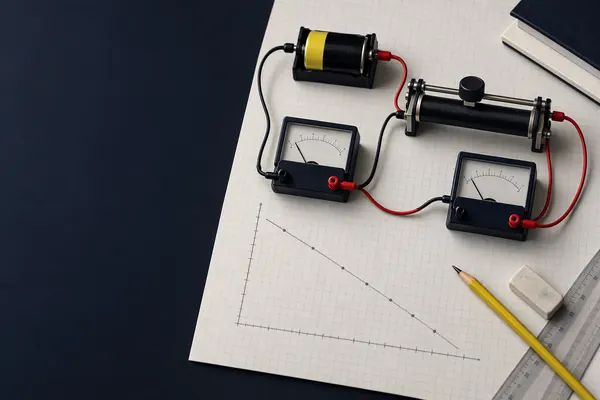
If you have already studied resistance and resistivity and potential dividers, you have met all the ideas you need. You are now treating the cell's own internal resistance as one more resistor in series. All Module 4 topics are listed on the Module 4 hub.
The equations
Conservation of energy applied to one coulomb of charge going round the circuit gives the key result. The energy supplied by the cell is ε. The energy transferred in the external resistor is V = IR, and the energy wasted in the internal resistor is Ir. So ε = V + Ir. Substituting V = IR gives ε = IR + Ir = I(R + r).
ε = I(R + r)
- ε = emf of the cell (V)
- I = current in the circuit (A)
- R = external resistance (Ω)
- r = internal resistance of the cell (Ω)
This is Kirchhoff's second law for the circuit: the emf equals the sum of the p.d.s around the loop.
V = ε − Ir
- V = terminal p.d., the p.d. across the external circuit (V)
- Ir = lost volts, the p.d. across the internal resistance (V)
V = IR for the external resistor, so V is also the p.d. across the cell's terminals while it is supplying current.
The terminal p.d. is only equal to the emf when I = 0, for example when a high-resistance voltmeter is connected directly across the cell. That is why the reading on such a voltmeter is taken as the emf. As soon as a current flows, V is less than ε by the lost volts Ir.
For a given cell, the more current you draw, the more volts are lost. A short circuit (R close to 0) gives the maximum current I = ε / r and almost zero terminal p.d. That is why shorting a battery makes it heat up so quickly: all the energy goes into the internal resistance.
The V-I graph: gradient and intercept
Rearranging V = ε − Ir gives V = −rI + ε, which has the form y = mx + c. A graph of terminal p.d. V (vertical) against current I (horizontal) is a straight line with a negative gradient.
- Gradient = −r. The internal resistance is the magnitude of the gradient.
- y-intercept = ε. This is the terminal p.d. when I = 0.
- x-intercept = ε / r. This is the short-circuit current, found by extending the line, though real cells do not behave perfectly this way at large current.
Be careful if the question plots something different. If you plot I against V, the gradient is −1/r. If you plot 1/I against R, the equation ε = I(R + r) rearranges to R = ε/I − r, so a graph of R against 1/I has gradient ε and intercept −r. Always rearrange into y = mx + c before you read anything off.
Practical: measuring emf and internal resistance
OCR's practical activity groups include determining the emf and internal resistance of a cell. The standard method is as follows.
- Connect the cell in series with an ammeter, a variable resistor and a switch. Connect a voltmeter directly across the cell terminals.
- Close the switch and adjust the variable resistor to give a current. Record the current and the terminal p.d.
- Change the resistance to get at least six different currents, and switch off between readings.
- Plot V against I and draw a line of best fit. Read the gradient and the y-intercept.
- The magnitude of the gradient is r and the intercept is ε.
Power and maximum power transfer
The total power supplied by the cell is P = εI. Of that, I²r is wasted in the cell and I²R is delivered to the external resistance. The delivered power is P = I²R = ε²R / (R + r)².
If R is very small, the current is large but the p.d. across R is tiny, so little power reaches the load. If R is very large, the current is small. The delivered power is greatest between these extremes, when R = r. This is called maximum power transfer, and the maximum power is ε² / 4r.
At maximum power transfer exactly half of the cell's power is wasted in the internal resistance, so the efficiency is only 50%. For devices where energy loss matters, such as a battery supplying a motor, you want R much greater than r so the efficiency is high, even though the power delivered is below its maximum.
Cells in series and in parallel
Identical cells can be combined to change the emf, the internal resistance, or both. The rules follow from the series and parallel resistor rules in potential divider circuits.
| Arrangement | Total emf | Total internal resistance | Effect |
|---|---|---|---|
| n in series | nε | nr | Higher p.d., higher internal resistance |
| n in parallel | ε | r / n | Same p.d., lower internal resistance, and the cells last longer |
Cells in series are used when you need a bigger p.d., such as in a torch. Cells in parallel are used when you need to supply a larger current for longer without the p.d. dropping as much. Cells in parallel do not give a higher emf.
Worked examples
Lost volts
A battery has emf 12.0 V and internal resistance 0.50 Ω. It is connected to a 5.5 Ω resistor. Calculate (a) the current, (b) the terminal p.d., (c) the lost volts.
- (a) ε = I(R + r), so I = ε / (R + r) = 12.0 / (5.5 + 0.50) = 12.0 / 6.0 = 2.0 A.
- (b) Terminal p.d. V = IR = 2.0 × 5.5 = 11.0 V.
- (c) Lost volts = Ir = 2.0 × 0.50 = 1.0 V.
- Check: ε − Ir = 12.0 − 1.0 = 11.0 V, which matches (b).
Answer (a) 2.0 A; (b) 11.0 V; (c) 1.0 V.
Finding ε and r from a graph
A student measures terminal p.d. V for different currents I from a cell: (0.10 A, 1.44 V), (0.30 A, 1.32 V) and (0.50 A, 1.20 V). Use the data to find ε and r. Hence calculate the short-circuit current.
- The points are on a straight line. Gradient = (1.20 − 1.44) / (0.50 − 0.10) = −0.24 / 0.40 = −0.60 V A⁻¹.
- So r = 0.60 Ω.
- Intercept: V = ε − Ir, so ε = 1.44 + 0.10 × 0.60 = 1.50 V.
- Short-circuit current = ε / r = 1.50 / 0.60 = 2.5 A.
Answer ε = 1.50 V, r = 0.60 Ω, short-circuit current 2.5 A.
Maximum power
A cell of emf 6.0 V and internal resistance 2.0 Ω is connected to a variable external resistor. Calculate the power delivered to the external resistor for R = 1.0 Ω, 2.0 Ω and 4.0 Ω. For which value is it largest?
- P = ε²R / (R + r)².
- R = 1.0 Ω: I = 6.0 / 3.0 = 2.0 A, so P = I²R = 4.0 × 1.0 = 4.0 W.
- R = 2.0 Ω: I = 6.0 / 4.0 = 1.5 A, so P = 2.25 × 2.0 = 4.5 W.
- R = 4.0 Ω: I = 6.0 / 6.0 = 1.0 A, so P = 1.0 × 4.0 = 4.0 W.
- The largest power occurs when R = r = 2.0 Ω.
Answer 4.0 W, 4.5 W and 4.0 W respectively. The maximum power transfer is when R = r.
Cells in series and in parallel
Two identical cells, each of emf 1.5 V and internal resistance 0.30 Ω, are connected to a 1.2 Ω resistor. Calculate the current in the resistor when the cells are connected (a) in series and (b) in parallel.
- (a) Series: ε = 3.0 V and r = 0.60 Ω. I = 3.0 / (1.2 + 0.60) = 3.0 / 1.8 = 1.67 A.
- (b) Parallel: ε = 1.5 V and r = 0.30 / 2 = 0.15 Ω. I = 1.5 / (1.2 + 0.15) = 1.5 / 1.35 = 1.11 A.
- The series arrangement gives the larger current in this resistor, because R is larger than r.
Answer (a) 1.7 A; (b) 1.1 A.
Common mistakes
- Using ε = IR instead of ε = I(R + r) when internal resistance matters.
- Calling the emf a "force", or saying it is the p.d. across the cell when current flows.
- Saying that cells in parallel give a bigger emf.
- Forgetting that the terminal p.d. is the same as the p.d. across the external resistance, V = IR.
- Quoting the maximum power when R = r but then saying the efficiency is 100%. It is 50%.
- Taking readings quickly without switching off, so the cell heats and the data drift.
How OCR A examines this topic
Expect a mixture of short calculation questions and longer practical-based questions. Common ones are finding the current or terminal p.d. from ε, R and r, reading ε and r from a V-I graph, and describing how the experiment is done and how to reduce error.
- Definitions: emf as energy transferred per unit charge by the source, and the difference from p.d.
- Calculations: terminal p.d., lost volts, current in a circuit with a real cell, power in the load.
- Graph work: rearranging to y = mx + c, finding the gradient and intercept, and sometimes handling a less obvious plot such as R against 1/I.
- Practical: circuit diagram, why readings are taken at intervals, safe current, and uncertainty in the gradient.
- Synoptic links: potential dividers, resistance and resistivity, and the capacitor discharge circuits in Module 6.
Practice questions
A cell has emf 1.5 V and internal resistance 0.50 Ω. It is connected to a 4.0 Ω resistor. Calculate the current and the terminal p.d.3 marks
Show the answer
Answer: 0.33 A and 1.3 V
I = ε / (R + r) = 1.5 / 4.5 = 0.333 A. V = IR = 0.333 × 4.0 = 1.33 V.
A battery of emf 6.0 V supplies a current of 2.0 A and its terminal p.d. is 5.6 V. Calculate its internal resistance.2 marks
Show the answer
Answer: 0.20 Ω
Lost volts = 6.0 − 5.6 = 0.40 V. r = 0.40 / 2.0 = 0.20 Ω.
A car battery has emf 12 V and internal resistance 0.020 Ω. The starter motor draws 200 A. Calculate the terminal p.d. while the motor is running.2 marks
Show the answer
Answer: 8.0 V
Lost volts = Ir = 200 × 0.020 = 4.0 V. V = 12 − 4.0 = 8.0 V.
For the circuit in worked example 1 (ε = 12.0 V, r = 0.50 Ω, R = 5.5 Ω), calculate the total power supplied by the battery, the power wasted in the battery, and the power delivered to the resistor.3 marks
Show the answer
Answer: 24 W, 2.0 W and 22 W
I = 2.0 A. Total power = εI = 12.0 × 2.0 = 24 W. Wasted = I²r = 4.0 × 0.50 = 2.0 W. Delivered = I²R = 4.0 × 5.5 = 22 W. Check: 2.0 + 22 = 24 W.
A cell has emf 9.0 V and internal resistance 3.0 Ω. State the value of external resistance that gives maximum power transfer, and calculate that maximum power.3 marks
Show the answer
Answer: R = 3.0 Ω and P = 6.75 W
Maximum power when R = r = 3.0 Ω. I = 9.0 / 6.0 = 1.5 A. P = I²R = 2.25 × 3.0 = 6.75 W.
Three identical cells, each of emf 1.5 V and internal resistance 0.90 Ω, are connected in series to a 2.3 Ω resistor. Calculate the current and the p.d. across the resistor.4 marks
Show the answer
Answer: 0.90 A and 2.1 V
Total emf = 4.5 V, total r = 2.7 Ω. I = 4.5 / (2.3 + 2.7) = 4.5 / 5.0 = 0.90 A. V = IR = 0.90 × 2.3 = 2.07 V.
Next steps
To see how voltage is shared in more complex circuits, revisit potential divider circuits. For the idea of resistance itself, see resistance and resistivity. When you are ready, practise this topic with step-by-step marking, free to start.
Frequently asked questions
What is the difference between emf and terminal p.d.?
The emf is the energy the source transfers to each coulomb of charge, and it is the p.d. across the cell when no current flows. The terminal p.d. is the p.d. across the cell's terminals when a current flows, and is lower than the emf by the lost volts Ir.
What are lost volts?
Lost volts are the p.d. across the internal resistance of the cell, equal to Ir. They represent energy wasted inside the cell per coulomb, so they reduce the terminal p.d. below the emf.
How do you find internal resistance from a graph?
Plot terminal p.d. V against current I. The gradient is −r, so the internal resistance is the size of the gradient. The intercept on the V axis is the emf.
When is power transfer from a cell a maximum?
The power delivered to the external resistor is greatest when the external resistance equals the internal resistance, R = r. At that point the delivered power is ε² / 4r and the efficiency is 50%.
Why does a battery's voltage drop when it is under load?
A current flowing through the internal resistance causes a p.d. Ir across it. Because ε = V + Ir, the terminal p.d. V falls as the current increases.
Related guides
Written for the OCR A Level Physics A (H556) specification. Questions are original and written in exam style; they are not taken from OCR papers. Spotted a mistake? Tell us.