Key points
- Q = Q₀e^(−t/CR), and V and I decay in exactly the same way.
- The time constant τ = CR is the time to fall to 37% (e⁻¹) of the initial value.
- Half-life of a discharge: t½ = CR ln 2 = 0.69CR.
- A graph of ln Q (or ln V) against t is a straight line with gradient −1/CR.
- Charging: V = V₀(1 − e^(−t/CR)), reaching 63% of V₀ after one time constant.
- Step method: ΔQ = −(Q/CR)Δt, which slightly underestimates the charge.
What capacitor discharge is
A capacitor discharge happens when a charged capacitor is connected across a resistor and its stored charge leaks away through the circuit. The charge, p.d. and current all fall exponentially: quickly at first, then more and more slowly. If you are searching for the capacitor discharge equation, it is Q = Q₀e^(−t/CR), and the rest of this guide shows you how to use it.
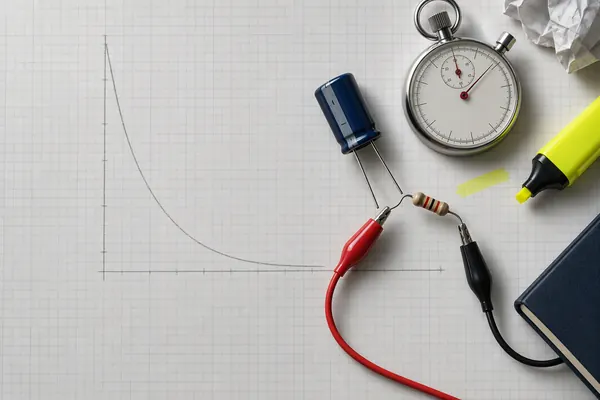
Here is the idea in plain terms. A charged capacitor has a p.d. across it. When you connect a resistor, that p.d. pushes a current round the circuit. The current takes charge off the plates, so the p.d. falls. A lower p.d. gives a smaller current, so the charge leaves more slowly. That feedback loop, where the rate of loss depends on how much is left, is what makes the decay exponential.
The same pattern appears in radioactive decay, so it is worth noticing the link now. In both cases the rate of change is proportional to the amount present. If you can handle one, you can handle the other: see radioactive decay and half-life.
This topic sits in the Capacitors part of module 6. It builds on capacitance and energy stored, so make sure you are happy with C = Q/V before you go further.
The discharge equations and what each symbol means
You will find the equation for Q in the data and formulae booklet, but you must be able to apply it to V and I as well, and rearrange it using natural logarithms. Because Q = CV and V = IR, all three quantities decay with the same time constant.
Q = Q₀e^(−t/CR)
- Q = charge on the capacitor at time t (C)
- Q₀ = initial charge at t = 0 (C)
- t = time since discharge began (s)
- C = capacitance (F)
- R = resistance of the discharge resistor (Ω)
- e = the exponential constant, 2.718…
V = V₀e^(−t/CR) and I = I₀e^(−t/CR)
- V = p.d. across the capacitor at time t (V)
- V₀ = initial p.d. (V)
- I = discharge current at time t (A)
- I₀ = initial current, V₀/R (A)
Divide Q = Q₀e^(−t/CR) by C to get the V form. Divide the V form by R to get the I form. The CR in the exponent never changes.
Notice that the exponent −t/CR has no units. C × R is measured in seconds (farad × ohm = second), so t divided by CR is a pure number. If you ever find a unit left on the exponent, something has gone wrong.
| Quantity | Initial value | Where it comes from |
|---|---|---|
| Charge Q₀ | CV₀ | C = Q/V |
| Current I₀ | V₀/R | V = IR, with the full p.d. across R at the start |
| P.d. V₀ | the p.d. it was charged to | given in the question |
The time constant τ = CR
The product CR is called the time constant, written τ. It is a measure of how slowly the capacitor discharges: a big capacitance holds more charge to remove, and a big resistance slows the current down, so either one makes the discharge slower.
τ = CR
- τ = time constant (s)
- C = capacitance (F)
- R = resistance (Ω)
Put t = τ into Q = Q₀e^(−t/CR) and you get Q = Q₀e⁻¹ = 0.368Q₀. So the time constant has a clear physical meaning: after one time constant, the charge (and p.d. and current) has fallen to about 37% of its starting value. After 2τ it is e⁻² = 0.135 (about 14%), and after 5τ it is e⁻⁵ = 0.0067, under 1%. In practice, a capacitor is treated as fully discharged after about 5τ.
| Time | Fraction remaining | Percentage remaining |
|---|---|---|
| τ | e⁻¹ = 0.368 | 36.8% |
| 2τ | e⁻² = 0.135 | 13.5% |
| 3τ | e⁻³ = 0.050 | 5.0% |
| 5τ | e⁻⁵ = 0.0067 | 0.67% |
The 63% figure belongs to charging. While charging, the p.d. rises to 1 − e⁻¹ = 0.632 of its final value after one time constant, so it has covered 63% of the way. The two numbers describe the same fact from two sides: after τ, a discharge has lost 63% and kept 37%.
Two useful graph features follow from this. First, the tangent drawn at t = 0 hits the time axis at t = τ. Second, the curve never reaches zero in the mathematics, it just gets closer and closer. Do not draw a decay curve that crosses the axis.
Half-life of a discharge
Just as in radioactive decay, you can ask how long it takes the charge to halve. Set Q = Q₀/2 in the equation, so ½ = e^(−t½/CR). Take natural logs of both sides: ln ½ = −t½/CR, which gives t½ = CR ln 2.
t½ = CR ln 2 = 0.69CR
- t½ = time for Q, V or I to fall to half its value (s)
- ln 2 = 0.693 (to 3 s.f.)
The half-life is the same wherever you start on the curve, because the decay is exponential. It is shorter than τ, since the curve only needs to fall to 50%, not 37%.
The half-life is independent of the starting charge. If the p.d. falls from 8.0 V to 4.0 V in 10 s, it will fall from 4.0 V to 2.0 V in the next 10 s. Checking for a constant half-life is a good way to confirm that a decay is exponential.
Straight-line graphs using natural logs
A curved graph is hard to measure from. Taking natural logs turns the exponential into a straight line, which is how you find CR experimentally. Start with Q = Q₀e^(−t/CR) and take ln of both sides.
ln Q = ln Q₀ − t/CR
- ln Q plotted on the y-axis
- t plotted on the x-axis
- ln Q₀ = y-intercept
- −1/CR = gradient (s⁻¹)
Compare with y = mx + c. The same works for V and I: ln V = ln V₀ − t/CR and ln I = ln I₀ − t/CR.
So a graph of ln Q (or ln V, or ln I) against t is a straight line with a negative gradient equal to −1/CR. The intercept on the vertical axis is the natural log of the initial value. From the gradient you get τ = −1/gradient, and from τ you can find C if you know R, or R if you know C.
Always use ln, not log₁₀, for this graph. If you plot log₁₀ V you get a straight line with gradient −1/(2.303 CR), and it is easy to forget the factor. If a question does give you log₁₀ values, convert before you use the equation.
Charging a capacitor through a resistor
When a capacitor charges from a supply through a resistor, the current starts large and falls, and the p.d. across the capacitor rises towards the supply p.d. The charge and p.d. follow a rising exponential, while the current still decays exponentially.
Q = Q₀(1 − e^(−t/CR)) V = V₀(1 − e^(−t/CR)) I = I₀e^(−t/CR)
- Q₀ = final charge on the capacitor (C)
- V₀ = final p.d., equal to the supply p.d. (V)
- I₀ = initial charging current, V₀/R (A)
The time constant CR is the same as in discharge. Check what your booklet gives you, and be ready to explain the charging form even if you have to quote it.
At t = 0 the capacitor is uncharged, so all the supply p.d. is across the resistor and the current is V₀/R. As the capacitor charges, its p.d. opposes the supply, the p.d. across the resistor drops, and so does the current. At any time the supply p.d. equals the p.d. across the capacitor plus the p.d. across the resistor.
A quick check for sketches: the charging curve starts with the steepest gradient and levels off at V₀. The discharging curve starts at V₀ with the steepest gradient and levels off at zero. The gradient is never constant.
Modelling the discharge step by step
You can also model discharge without the exponential equation, using small time steps. This is how a spreadsheet does it, and it shows where the exponential comes from. The current at any moment is I = V/R = Q/CR, and current is the rate of loss of charge, so in a short time Δt the charge changes by:
ΔQ = −(Q / CR) Δt
- ΔQ = change in charge in one step (C), negative because charge is lost
- Q = charge at the start of the step (C)
- Δt = time step (s)
The new charge is Q + ΔQ. Repeat the step, using the new Q each time.
In a spreadsheet, set up columns for t, Q, ΔQ and the new Q. Fill in the first row by hand, then fill the formulae down. Make Δt small compared with CR (a tenth of CR or smaller is a sensible start) and compare with the exact equation. A smaller Δt gives a closer match.
The step method slightly underestimates the charge. It uses the gradient at the start of each step, which is steeper than the average over that step, so each step takes off a little too much charge. The error shrinks as Δt shrinks. Be ready to say this in an evaluation question.
Worked examples
Time constant and time to fall to a given p.d.
A 4700 μF capacitor is charged to 9.0 V and discharged through a 22 kΩ resistor. (a) Calculate the time constant. (b) Calculate the initial charge and the initial current. (c) Calculate the time taken for the p.d. to fall to 3.0 V.
- (a) τ = CR = 4700 × 10⁻⁶ F × 22 × 10³ Ω = 103.4 s.
- (b) Q₀ = CV₀ = 4700 × 10⁻⁶ × 9.0 = 0.0423 C.
- I₀ = V₀/R = 9.0 / (22 × 10³) = 4.09 × 10⁻⁴ A.
- (c) V = V₀e^(−t/CR), so 3.0 = 9.0e^(−t/103.4). Rearrange: e^(−t/103.4) = 1/3.
- Take natural logs: −t/103.4 = ln(1/3) = −1.0986.
- t = 1.0986 × 103.4 = 113.6 s.
Answer (a) τ = 103 s. (b) Q₀ = 0.042 C and I₀ = 0.41 mA. (c) t = 114 s (about 1.9 minutes).
Finding R from a ln graph
A student discharges a 470 μF capacitor through an unknown resistor and plots a graph of ln V against t. The line is straight with a gradient of −0.0250 s⁻¹. (a) Calculate the time constant. (b) Calculate the resistance R.
- (a) The gradient of the ln V against t graph is −1/CR, so 1/CR = 0.0250 s⁻¹.
- τ = CR = 1 / 0.0250 = 40.0 s.
- (b) R = τ / C = 40.0 / (470 × 10⁻⁶) = 8.51 × 10⁴ Ω.
Answer τ = 40 s and R = 85 kΩ (to 2 s.f.).
Using the step-by-step method
A 100 μF capacitor holding 600 μC of charge discharges through a 10 kΩ resistor. Use ΔQ = −(Q/CR)Δt with Δt = 0.20 s to estimate the charge after 0.40 s, and compare it with the exact value.
- CR = 100 × 10⁻⁶ × 10 × 10³ = 1.0 s.
- Step 1: ΔQ = −(600 / 1.0) × 0.20 = −120 μC, so Q = 600 − 120 = 480 μC at t = 0.20 s.
- Step 2: ΔQ = −(480 / 1.0) × 0.20 = −96 μC, so Q = 480 − 96 = 384 μC at t = 0.40 s.
- Exact: Q = 600e^(−0.40/1.0) = 600 × 0.6703 = 402 μC.
Answer The step method gives 384 μC and the exact value is 402 μC. The step method is lower because it uses the steeper gradient at the start of each step. A smaller Δt would reduce the difference.
Charging through a resistor
A 47 μF capacitor, initially uncharged, charges from a 12 V supply through a 100 kΩ resistor. (a) Calculate the time constant. (b) Calculate the p.d. across the capacitor after one time constant. (c) Calculate the time for the p.d. across the capacitor to reach 10 V.
- (a) τ = CR = 47 × 10⁻⁶ × 100 × 10³ = 4.7 s.
- (b) V = V₀(1 − e⁻¹) = 12 × (1 − 0.368) = 12 × 0.632 = 7.59 V.
- (c) 10 = 12(1 − e^(−t/4.7)), so 1 − e^(−t/4.7) = 0.8333 and e^(−t/4.7) = 0.1667.
- −t/4.7 = ln(0.1667) = −1.792, so t = 1.792 × 4.7 = 8.42 s.
Answer (a) 4.7 s. (b) 7.6 V. (c) 8.4 s.
Common mistakes
- Forgetting to convert units. μF must become 10⁻⁶ F and kΩ must become 10³ Ω. A time constant that is a million times too big or small points to a missed prefix.
- Using log instead of ln. The equation uses base e, so you need ln to undo it. Rearranging e^(−t/CR) = 0.50 as −t/CR = log 0.50 gives the wrong answer.
- Dropping the minus sign. ln of a fraction less than 1 is negative, and so is −t/CR. Check that your time comes out positive.
- Thinking the capacitor is empty after one time constant. After τ, 37% of the charge is still there.
- Mixing up charging and discharging. For charging, V rises towards V₀. For discharging, V falls from V₀. The current decays in both.
- Describing the decay as linear. Exponential decay means a constant fraction lost per unit time, not a constant amount.
- Reading the gradient with a tiny triangle. A small triangle on a ln graph magnifies reading errors. Use at least half the line.
How OCR A examines capacitor discharge
Capacitors are in Module 6, so expect them in the papers that assess that module (Exploring physics) and in the synoptic paper (Unified physics). Check your own copy of the specification for the exact paper coverage. Typical questions are short calculations (find τ, a charge or a time), graph work (sketch or interpret a decay curve or a ln graph) and explanation.
Command words matter. 'Show that' means you must write out the working and finish with the stated value, usually to one more significant figure than the answer given. 'Explain' needs a chain of reasoning, such as 'the p.d. across the resistor falls, so the current falls, so charge is removed more slowly'. 'Sketch' wants the correct shape, intercepts and labelled axes, not accurate plotting.
Evaluating the practical is a common skill. Reading the voltmeter is difficult when the p.d. falls quickly, so a larger CR makes timing easier. Capacitors can have large tolerances, often 20% or more for electrolytic types, so your measured τ may differ from the nominal CR. A voltmeter with a finite resistance also discharges the capacitor through itself, which makes the measured time constant smaller. A data logger with a high input resistance reduces this problem.
Synoptic links. The exponential form links to radioactive decay and half-life. The energy stored in the capacitor, W = ½QV, is covered in capacitors in series and parallel, and the current calculation uses ideas from resistance and resistivity.
Practice questions
A 330 μF capacitor discharges through a 15 kΩ resistor. Calculate the time constant, and state the fraction of the initial charge remaining after that time.3 marks
Show the answer
Answer: τ = 4.95 s. About 37% (0.37Q₀) remains.
τ = CR = 330 × 10⁻⁶ × 15 × 10³ = 4.95 s. At t = τ, Q = Q₀e⁻¹ = 0.368Q₀.
A 100 μF capacitor charged to 6.0 V discharges through a 47 kΩ resistor. Calculate the p.d. across the capacitor after 2.0 s.3 marks
Show the answer
Answer: 3.9 V.
CR = 100 × 10⁻⁶ × 47 × 10³ = 4.7 s. V = 6.0e^(−2.0/4.7) = 6.0 × 0.6534 = 3.92 V.
A 1000 μF capacitor discharges through a 4.7 kΩ resistor. Calculate how long it takes for the charge to fall to 20% of its initial value.3 marks
Show the answer
Answer: 7.6 s.
CR = 1000 × 10⁻⁶ × 4.7 × 10³ = 4.7 s. 0.20 = e^(−t/4.7), so t = 4.7 × ln 5 = 4.7 × 1.609 = 7.56 s.
A graph of ln V against t for a discharging capacitor (V in volts) passes through (0, 2.20) and (30 s, 0.70). The capacitance is 1000 μF. Calculate the initial p.d. and the resistance.4 marks
Show the answer
Answer: V₀ = 9.0 V and R = 20 kΩ.
V₀ = e^2.20 = 9.03 V, so 9.0 V. Gradient = (0.70 − 2.20)/30 = −0.0500 s⁻¹, so CR = 20 s. R = 20 / (1000 × 10⁻⁶) = 2.0 × 10⁴ Ω.
A 2200 μF capacitor charged to 12 V discharges through a 10 kΩ resistor. Calculate the initial current, and the current after 10 s.4 marks
Show the answer
Answer: I₀ = 1.2 mA and I = 0.76 mA after 10 s.
I₀ = 12 / 10 000 = 1.2 × 10⁻³ A. CR = 2200 × 10⁻⁶ × 10 × 10³ = 22 s. I = 1.2 × 10⁻³ × e^(−10/22) = 1.2 × 10⁻³ × 0.635 = 7.6 × 10⁻⁴ A.
Explain why a step-by-step calculation of discharge with a large time step gives a charge that is too low.2 marks
Show the answer
Answer: Each step uses the gradient at the start of the step, which is steeper than the average gradient across it, so too much charge is removed in each step.
The true rate of loss falls throughout each step. Using the starting value overestimates the loss.
Next steps
Once you are comfortable with discharge, move on to capacitors in series and parallel for energy stored and combining capacitors. The same exponential ideas return in radioactive decay and half-life, and the resistor side of the circuit is covered in emf and internal resistance. See all topics on the module 6 hub. When you are ready, practise this topic with step-by-step marking. It is free to start.
Frequently asked questions
What is the capacitor discharge equation?
It is Q = Q₀e^(−t/CR). Q is the charge at time t, Q₀ is the starting charge, C is the capacitance and R is the resistance. The same equation works for the p.d. across the capacitor and the current in the circuit.
What does the time constant τ = CR mean?
The time constant is the time taken for the charge, p.d. or current to fall to 1/e, which is about 37%, of its starting value. A larger capacitance or resistance gives a larger time constant and a slower discharge. It is measured in seconds.
Why do we plot ln V against t for a discharging capacitor?
Taking natural logs of V = V₀e^(−t/CR) gives ln V = ln V₀ − t/CR, which is a straight line. The gradient is −1/CR and the intercept is ln V₀. A straight line is easier to measure and to test than a curve.
Does a capacitor ever fully discharge?
In the mathematical model, the charge only reaches zero after infinite time. In practice, after about 5τ less than 1% of the charge remains, so it is treated as fully discharged. Real capacitors also have some leakage.
How do you find the half-life of a capacitor discharge?
Set Q = Q₀/2 and take natural logs, which gives t½ = CR ln 2 = 0.69CR. The half-life is the same at any point on the curve, as with radioactive decay.
What is the difference between charging and discharging equations?
In discharge, Q and V fall as Q₀e^(−t/CR). In charging, they rise as Q₀(1 − e^(−t/CR)). The current decays exponentially in both cases, and the time constant CR is the same.
Related guides

Written for the OCR A Level Physics A (H556) specification. Questions are original and written in exam style; they are not taken from OCR papers. Spotted a mistake? Tell us.