Key points
- Hooke's law: extension is directly proportional to the force applied, F = kx, up to the limit of proportionality.
- Stress = F/A (Pa) and strain = x/L (no unit). The Young modulus E = stress/strain is the gradient of the straight part of a stress-strain graph.
- Elastic deformation is reversed when the force is removed. Plastic deformation leaves a permanent change in length.
- Ductile materials show a plastic region before they break, brittle materials fracture with little or none, and polymers such as rubber show hysteresis.
- Elastic potential energy stored in a stretched material is the area under the force-extension graph, ½Fx when Hooke's law is obeyed.
What the Young modulus tells you
The Young modulus is a measure of how stiff a material is. A material with a high Young modulus, such as steel, needs a very large stress to produce a small strain. One with a low Young modulus, such as rubber, stretches easily. Because stress and strain take away the effect of the sample's size, it lets you compare materials, not just particular wires or rods.
The distinction between stiffness of an object and stiffness of a material matters. The spring constant k tells you how stiff a particular object is, and a long, thin wire has a smaller k than a short, thick one of the same material. The Young modulus tells you how stiff the material itself is, and it is the same for both wires.
This guide starts with Hooke's law and force-extension graphs, then defines stress, strain and E, compares stress-strain curves for different materials, covers elastic potential energy and finishes with the long-wire practical. The Module 3 hub shows where it sits in the course.
Hooke's law and force-extension graphs
Hooke's law says that the extension of a spring, wire or other sample is directly proportional to the force applied, as long as the limit of proportionality is not exceeded.
F = kx
- F = force applied, in N
- k = force constant (spring constant) of the object, in N m⁻¹
- x = extension (change in length), in m
- Limit of proportionality (P): beyond this point the graph is no longer a straight line, so force is no longer proportional to extension.
- Elastic limit (E): beyond this point the material does not return to its original length when the force is removed. It is often very close to P.
- Elastic deformation: the sample returns to its original length when the force is removed, because the atoms are only moved a short way and return to their positions.
- Plastic deformation: some of the atoms have slipped to new positions, so there is a permanent change in length.
A spring is not the same as a wire, but both obey Hooke's law at small loads. For a spring, the graph keeps its straight shape over a much larger extension. Remember that the limit of proportionality and the elastic limit are different points, even if they are close.
Stress, strain and the Young modulus
To compare materials, we divide the force by the cross-sectional area to get stress, and divide the extension by the original length to get strain.
stress σ = F / A
- F = tensile force, in N
- A = cross-sectional area, in m²
- σ = stress, in Pa (1 Pa = 1 N m⁻²)
strain ε = x / L
- x = extension, in m
- L = original length, in m
- ε = strain (a ratio, so it has no unit)
E = σ / ε = (F / A) / (x / L) = FL / Ax
- E = Young modulus, in Pa
Valid only below the limit of proportionality. For a wire, A = πd²/4, where d is the diameter.
Comparing F = kx with E = FL/Ax gives k = EA/L. This is why a longer wire is less stiff (larger L gives smaller k) and a thicker one is stiffer. The Young modulus of steel is about 2 × 10¹¹ Pa, which is much greater than the stress that most structures put on it, so the strain is very small.
The units are worth checking. Force in N divided by area in m² gives N m⁻², which is the pascal. Strain is a length divided by a length, so E has the same unit as stress. When the diameter is in mm, convert it to m before you work out the area, and remember that d² means a factor of 10⁻⁶ when you go from mm² to m².
Stress-strain curves: ductile, brittle and polymeric materials
Plotting stress against strain removes the effect of the sample's size, so the curve shows the properties of the material.
| Type | Behaviour | Example |
|---|---|---|
| Ductile | Straight line (elastic), yield point, large plastic region, then fracture. Can be drawn into wires. | Copper, mild steel |
| Brittle | Straight line to the breaking point, with no or very little plastic deformation. Breaks suddenly and often shatters. | Glass, ceramics |
| Polymeric | Not a straight line. A rubber band can reach very large strains and return to its original length, but the unloading curve is different from the loading curve. | Rubber, polythene |
There is a set of terms to define. Write each as a short statement.
- Stiffness: a stiff material has a large Young modulus (steep gradient on a stress-strain graph).
- Strength: the ultimate tensile stress is the maximum stress the material can withstand before it begins to fail. A strong material has a high value.
- Toughness: a tough material absorbs a lot of energy before it breaks, so the area under its stress-strain curve is large.
- Ductile and brittle: ductile materials deform plastically before breaking, brittle materials do not.
- Yield point: the stress at which a ductile metal begins to deform plastically with a sharp increase in strain.
Stiff, strong and tough are three different ideas. Glass is stiff and strong in compression but brittle, so it is not tough. Rubber is not stiff, but it can be tough.
Elastic potential energy and the area under the graph
When you stretch a material, you do work, and if the deformation is elastic that work is stored as elastic potential energy. The work done by a force is force × distance moved, but the force rises as the sample stretches, so you use the area under the force-extension graph.
E_el = ½Fx = ½kx²
- E_el = elastic potential energy stored, in J
- F = final force, in N
- x = extension, in m
- k = force constant, in N m⁻¹
The area of the triangle under a straight-line F-x graph is ½ × base × height = ½Fx. This only works while Hooke's law holds. Otherwise find the area by counting squares or splitting the graph into shapes.
For the same sample, energy per unit volume is also useful. Dividing the energy by the volume AL gives ½(F/A)(x/L), so the energy stored per unit volume is ½ × stress × strain, the area under a stress-strain graph. This is why the area under a stress-strain curve is a measure of toughness.
If the material is stretched beyond the elastic limit and then unloaded, not all of the work is recovered. Some goes into the plastic deformation, and is transferred as thermal energy. The recoverable part is the area under the unloading line, shown on the force-extension graph above as the triangle between the unloading line and the extension axis.
Practical: the Young modulus of a wire
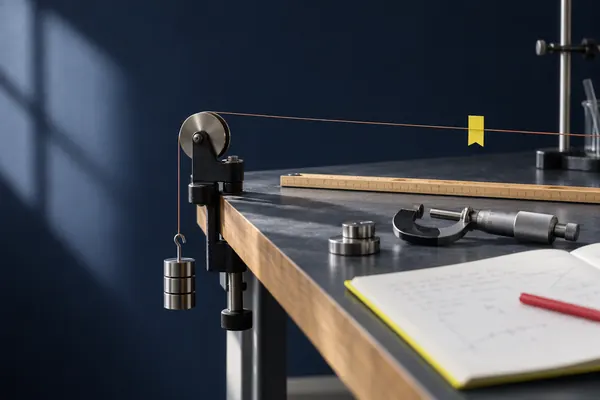
This is the standard experiment on the topic. A long, thin wire is clamped at one end, runs over a pulley, and carries a weight hanger at the other end. Adding loads in steps stretches the wire, and you measure the extension for each load.
- Fix one end of a long (about 2 m) thin wire firmly in a clamp and run it over a pulley, with a weight hanger at the other end. Wear safety glasses and put a tray of sand under the weights.
- Measure the original length L from the clamp to a marker on the wire, using a metre rule. Use the same marker position throughout.
- Measure the diameter of the wire with a micrometer at several points along it and in two perpendicular directions. Take the mean, and then work out A = πd²/4.
- Add a small load first to straighten the wire, then record the position of the marker. Add loads in equal steps and record the extension each time. Take readings as you unload, too, as a check that the wire is still elastic.
- Plot force against extension, or stress against strain, and draw a line of best fit through the straight part. Find E from the gradient.
The most important point for uncertainties is that the extension is very small, often only a few millimetres, so the percentage uncertainty in x is usually the largest. The diameter is squared in the area, so its percentage uncertainty is doubled. The length is long, so the percentage uncertainty in L is small. Percentage uncertainties are added in an equation of the form E = FL/Ax.
Worked examples
Finding E from one set of readings
A steel wire of length 2.50 m and diameter 0.40 mm is stretched by a force of 40 N. The extension is 4.0 mm. Calculate (a) the stress, (b) the strain, (c) the Young modulus of the steel.
- (a) A = πd²/4 = π × (0.40 × 10⁻³)² / 4 = 1.257 × 10⁻⁷ m². (1 mark)
- Stress = F/A = 40 / 1.257 × 10⁻⁷ = 3.18 × 10⁸ Pa. (1 mark)
- (b) Strain = x/L = 4.0 × 10⁻³ / 2.50 = 1.6 × 10⁻³. (1 mark)
- (c) E = stress / strain = 3.183 × 10⁸ / 1.6 × 10⁻³ = 1.99 × 10¹¹ Pa. (2 marks)
Answer (a) 3.18 × 10⁸ Pa; (b) 1.6 × 10⁻³; (c) 2.0 × 10¹¹ Pa.
Using the gradient of a force-extension graph
A wire of length 1.80 m and diameter 0.30 mm gives a straight-line force-extension graph with gradient 5.6 × 10³ N m⁻¹. Calculate (a) the Young modulus of the wire, (b) the elastic potential energy stored when the force is 20 N, assuming Hooke's law is obeyed.
- (a) The gradient is F/x = k = EA/L, so E = kL/A. (1 mark)
- A = π × (0.15 × 10⁻³)² = 7.069 × 10⁻⁸ m². (1 mark)
- E = 5.6 × 10³ × 1.80 / 7.069 × 10⁻⁸ = 1.43 × 10¹¹ Pa. (1 mark)
- (b) x = F/k = 20 / 5.6 × 10³ = 3.57 × 10⁻³ m. (1 mark)
- Energy = ½Fx = ½ × 20 × 3.571 × 10⁻³ = 0.036 J. (1 mark)
Answer (a) 1.4 × 10¹¹ Pa; (b) 0.036 J, or 35.7 mJ.
Uncertainty in E
In a Young modulus experiment, the length of the wire is (2.000 ± 0.002) m, the diameter is (0.38 ± 0.01) mm, and for one load the extension is (5.0 ± 0.5) mm. The uncertainty in the force is negligible. Calculate the percentage uncertainty in E, and say which measurement contributes most.
- % uncertainty in L = 0.002 / 2.000 × 100 = 0.1%. (1 mark)
- % uncertainty in d = 0.01 / 0.38 × 100 = 2.6%. A depends on d², so % uncertainty in A = 2 × 2.6 = 5.3%. (1 mark)
- % uncertainty in x = 0.5 / 5.0 × 100 = 10%. (1 mark)
- E = FL/Ax, so add percentages: 0.1 + 5.3 + 10 = 15%. The extension contributes the most. (1 mark)
Answer About 15%. The extension (10%) contributes most.
Common mistakes
- Confusing stress and force, or strain and extension. Stress is force per unit area and strain is extension per unit length. They are not the same quantities.
- Forgetting to convert mm to m. A diameter of 0.40 mm is 0.40 × 10⁻³ m, and the area in m² is 1.26 × 10⁻⁷, not 1.26 × 10⁻¹.
- Using the diameter instead of the radius in A = πr². Halve the diameter first, or use πd²/4.
- Giving the unit of strain. Strain has no unit. The Young modulus is in Pa.
- Applying E = σ/ε beyond the limit of proportionality. The formula works only on the straight part of the graph.
- Treating the limit of proportionality and elastic limit as the same. They are close for many metals, but they are defined differently.
- Saying brittle means weak. Brittle means it fractures without plastic deformation. A brittle material can be strong.
- Using ½Fx for rubber. The graph is not a straight line, so you must find the area by counting squares.
How OCR A examines the Young modulus
This topic is in Module 3 (Forces and motion), under materials. Expect these styles.
- Calculations: stress, strain, E and extension from data, often combined with energy stored (½Fx).
- Graph questions: read E from the gradient of a stress-strain graph, k from a force-extension graph, or energy from an area.
- Description questions: describe or compare the behaviour of ductile, brittle and polymeric materials, and use terms such as elastic, plastic, yield and fracture accurately.
- Practical questions: describe how to measure E for a wire, identify the measurements that matter most for the uncertainty, and suggest improvements.
The Young modulus experiment is one of the practical activity groups (PAGs) in the OCR A course, so expect to analyse and evaluate a set of data for a wire. The topic links to simple harmonic motion (the spring as a Hooke's law oscillator), to momentum and impulse (crumple zones absorb energy through plastic deformation) and to resistance and resistivity, where the wire's dimensions also matter.
Practice questions
A steel wire of length 1.5 m and diameter 0.50 mm carries a load of 80 N. The Young modulus of the steel is 2.0 × 10¹¹ Pa. Calculate the extension of the wire.4 marks
Show the answer
Answer: 3.1 mm
A = π × (0.25 × 10⁻³)² = 1.963 × 10⁻⁷ m². Stress = 80 / 1.963 × 10⁻⁷ = 4.07 × 10⁸ Pa. Strain = 4.074 × 10⁸ / 2.0 × 10¹¹ = 2.04 × 10⁻³. Extension = strain × L = 2.037 × 10⁻³ × 1.5 = 3.06 mm.
A spring has a force constant of 250 N m⁻¹. Calculate the force needed to extend it by 0.080 m and the energy stored.3 marks
Show the answer
Answer: 20 N and 0.8 J
F = kx = 250 × 0.080 = 20 N. Energy = ½Fx = ½ × 20 × 0.080 = 0.8 J (or ½kx² = ½ × 250 × 0.080² = 0.8 J).
Wire A is made of the same material as wire B. Wire A is twice as long and has twice the diameter of wire B. The same force is applied to each. Show that the extension of A is half that of B.3 marks
Show the answer
Answer: The extension of wire A is half that of wire B.
x = FL/AE, and A ∝ d². For wire A, L doubles and A is four times as large, so x_A = F(2L) / (4A × E) = ½ × FL/AE = ½ x_B.
Describe the stress-strain graph of a ductile metal wire up to fracture, and say how it would differ for a brittle material.5 marks
Show the answer
Answer: Straight line through the origin (Hooke's law), then yield and a plastic region with large strain, then ultimate tensile stress and fracture. The brittle material is straight to fracture with no plastic region.
Include: the gradient of the straight part is the Young modulus; beyond the elastic limit the strain is permanent; stress calculated with the original area falls after the ultimate tensile stress because the wire necks; a brittle material breaks suddenly at a small strain.
Explain why the area between the loading and unloading curves for a rubber band is the energy dissipated, and what happens to that energy.3 marks
Show the answer
Answer: The area between the curves is the work done per unit volume that is not recovered on unloading. It is transferred as thermal energy, so the rubber warms slightly.
Area under the loading curve is the energy supplied per unit volume. Area under the unloading curve is the energy returned. The difference is the area between the curves.
Next steps
Practise the unit conversions, because most lost marks in this topic come from the diameter and the area. Then use momentum and impulse to see how materials absorb energy in crumple zones, and simple harmonic motion for springs and Hooke's law. The Module 3 hub has the full list. To practise this topic with step-by-step marking, start free.
Frequently asked questions
What is the Young modulus?
The Young modulus is the ratio of stress to strain for a material, E = (F/A)/(x/L), measured in pascals. It measures the stiffness of the material itself, so it does not depend on the sample's length or cross-sectional area. It applies only below the limit of proportionality.
How do you do the Young modulus experiment?
Hang known loads from a long thin wire, measure the original length with a metre rule, the diameter with a micrometer and the extension for each load. Plot stress against strain, or force against extension, and find E from the gradient. Stay below the elastic limit.
Why is the diameter of the wire so important in the experiment?
The cross-sectional area depends on the diameter squared, so its percentage uncertainty is doubled when you work out A. Measuring it at several places and in two directions, with a micrometer, reduces that uncertainty. The extension is often the biggest source of uncertainty, though.
What is the difference between elastic and plastic deformation?
In elastic deformation the material returns to its original length when the force is removed. In plastic deformation some of the change in length is permanent, because atoms have moved to new positions. The elastic limit separates the two.
What is the difference between the limit of proportionality and the elastic limit?
The limit of proportionality is the point beyond which extension is no longer proportional to force. The elastic limit is the point beyond which the material does not return to its original length when unloaded. For many metals they are very close.
How do you find the energy stored in a stretched wire?
The energy is the area under the force-extension graph. If Hooke's law is obeyed, it is a triangle, so energy = ½Fx = ½kx². For a non-linear graph, count squares or split the area into shapes.
Related guides

Written for the OCR A Level Physics A (H556) specification. Questions are original and written in exam style; they are not taken from OCR papers. Spotted a mistake? Tell us.