Key points
- Momentum p = mv is a vector in kg m s⁻¹ (the same as N s), so direction matters.
- Resultant force = rate of change of momentum: F = Δp/Δt. For constant mass this becomes F = ma.
- Impulse = FΔt = Δp, and it equals the area under a force-time graph.
- Total momentum is conserved in every collision and explosion if no external resultant force acts. Kinetic energy is conserved only in elastic collisions.
- For the same change in momentum, a longer collision time means a smaller average force, which is how crumple zones, airbags and seat belts protect people.
Momentum and impulse: the key idea
Momentum measures how hard it is to stop a moving object. A lorry and a bicycle moving at the same speed have very different momentum, and so do a bullet and a ball moving at very different speeds. Momentum depends on both the mass and the velocity, so a light object moving fast can have as much momentum as a heavy object moving slowly.
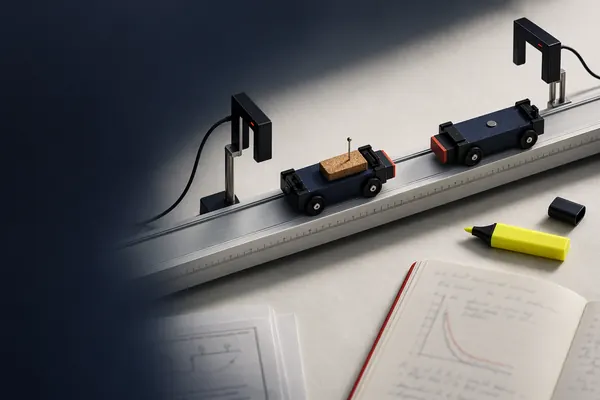
Impulse is the other half of the topic. A force acting for a time changes the momentum of an object, and that change is the impulse. This explains why you bend your knees when you land from a jump, why a cricketer draws their hands back as they catch a ball, and why cars have crumple zones. In each case the change in momentum is fixed, and what you can control is the time over which it happens.
This guide covers the equations, the force-time graph, conservation of momentum in one and two dimensions, elastic and inelastic collisions, explosions and safety features. Other Module 3 topics are on the Module 3 hub.
Momentum, Newton's second law and impulse
p = mv
- p = momentum, in kg m s⁻¹ (or N s)
- m = mass, in kg
- v = velocity, in m s⁻¹
Momentum is a vector, with the same direction as the velocity. Choose a positive direction and give velocities in the opposite direction a negative sign.
Newton's second law, in its most general form, says that the resultant force on an object is equal to the rate of change of its momentum, and acts in the direction of that change.
F = Δp / Δt = Δ(mv) / Δt
- F = resultant force, in N
- Δp = change in momentum, in kg m s⁻¹
- Δt = time over which the change happens, in s
If the mass is constant, Δ(mv) = mΔv, so F = mΔv/Δt = ma. The momentum form is the more general one: it also works when the mass changes, for example for a jet of water or a rocket.
Rearranging gives the impulse. The impulse of a force is the force multiplied by the time it acts, and it is equal to the change in momentum of the object.
impulse = FΔt = Δp = mv − mu
- m = mass, in kg
- u = initial velocity, in m s⁻¹
- v = final velocity, in m s⁻¹
Impulse is measured in N s, which is the same as kg m s⁻¹. If the force is not constant, FΔt is the average force multiplied by the time.
The unit equivalence is a favourite short question: 1 N s = 1 (kg m s⁻²) × s = 1 kg m s⁻¹. Show it in one line.
Force-time graphs
In most real impacts, the force is not constant. It rises as the objects deform, reaches a peak and falls back to zero. Because impulse is force × time, the impulse is the area under the force-time graph, whatever the shape.
- Area under the graph = impulse = change in momentum.
- Average force = area ÷ time = Δp/Δt.
- Gradient of a momentum-time graph = force. Do not confuse the two graphs.
- For a triangle, area = ½ × base × height. For other shapes, count squares or split into simple shapes.
The peak force can be much greater than the average. A short, sharp collision has a large peak, while a long, soft one has a small peak for the same change in momentum.
Conservation of momentum
The principle of conservation of momentum states that the total momentum of a system of objects stays constant, provided that no external resultant force acts on the system. In a collision, we usually treat the objects as a closed system for the very short time of the collision, because friction and air resistance are small compared with the collision forces.
It follows from Newton's laws. When two objects collide, they exert forces on each other that are equal in size and opposite in direction (Newton's third law), and the forces act for the same time. The impulses are therefore equal and opposite, so the changes in momentum are equal and opposite, and the total does not change.
m₁u₁ + m₂u₂ = m₁v₁ + m₂v₂
- m₁, m₂ = masses of the two objects, in kg
- u₁, u₂ = velocities before the collision, in m s⁻¹
- v₁, v₂ = velocities after the collision, in m s⁻¹
Treat velocities as signed numbers. An object moving to the left, if right is positive, has a negative velocity.
Collisions in two dimensions. Momentum is a vector, so it is conserved separately in any two perpendicular directions. Pick axes, usually along the initial velocity and at right angles to it, and write one conservation equation for each. You then have two equations, which is enough to find two unknowns, such as the speed and direction of the second object.
Elastic and inelastic collisions, and explosions
Momentum is conserved in all collisions. Kinetic energy is a different matter, and the type of collision is defined by what happens to it.
| Type | Momentum | Kinetic energy | Notes |
|---|---|---|---|
| Elastic | Conserved | Conserved | In 1D, the relative speed of approach equals the relative speed of separation. Collisions between atoms and gas molecules are close to elastic. |
| Inelastic | Conserved | Not conserved (some becomes thermal energy, sound and deformation) | Most real collisions. Total energy is still conserved. |
| Perfectly inelastic | Conserved | Maximum loss for the collision | The objects stick together and move with a common velocity. |
To show that a collision is elastic, calculate the total kinetic energy before and after and compare. If the question says the objects are 'rebounding with the same relative speed', you can use the relative speed test instead. Kinetic energy can also be written in terms of momentum, Ek = p²/2m, which is handy when you are given momenta.
Explosions. In an explosion, objects that were together move apart. If they start at rest, the total momentum before is zero, so the total momentum after is also zero: the fragments move in opposite directions with momenta that add to zero. A lighter fragment gets the larger speed. Unlike a collision, kinetic energy increases, because stored energy (chemical or elastic) is transferred to kinetic energy. A rifle recoils for the same reason: the bullet and the gun get equal and opposite momentum, so the heavy gun moves back slowly.
Crumple zones, airbags and seat belts
In a crash, the car and its passengers must lose all their momentum. The change in momentum is fixed by the mass and the speed. By F = Δp/Δt, the average force on the passenger depends on the time taken, so safety features are all designed to increase the time of the collision.
- Crumple zones deform plastically as the front of the car collapses, so the car takes longer to stop. They also absorb kinetic energy by doing work in permanently deforming the metal.
- Airbags let the head and chest slow down over a longer time, and they spread the force over a larger area, which reduces the pressure on the body.
- Seat belts stretch slightly, which increases the stopping time and stops the passenger hitting the dashboard or windscreen.
- Padded surfaces and bent knees work in the same way: a longer time for the same Δp gives a smaller force.
Notice what has not changed: the momentum lost is the same with or without the safety feature. A rigid car that stops in a very short time exerts a much larger force on its occupants. The crumple zone is not there to reduce the energy that must be removed, but to remove it more gently over a greater distance and time. This also links to the Young modulus topic, because the energy absorbed in plastic deformation is the area under a force-extension graph.
Worked examples
Impulse and average force
A tennis ball of mass 0.058 kg hits a wall horizontally at 24 m s⁻¹ and rebounds at 18 m s⁻¹. The contact time is 6.0 ms. Calculate the change in momentum and the average force on the ball.
- Take the direction towards the wall as positive. Initial velocity u = +24 m s⁻¹ and final velocity v = −18 m s⁻¹. (1 mark)
- Δp = m(v − u) = 0.058 × (−18 − 24) = 0.058 × (−42) = −2.436 kg m s⁻¹. (1 mark)
- F = Δp/Δt = −2.436 / 6.0 × 10⁻³ = −406 N. (1 mark)
- The magnitude is about 410 N, directed away from the wall. (1 mark)
Answer Δp = 2.44 kg m s⁻¹ away from the wall; average force = 406 N (about 410 N) away from the wall.
Impulse from a force-time graph
A force on a ball of mass 0.16 kg, initially at rest, rises uniformly from zero to a peak of 800 N in 5.0 ms and then falls uniformly to zero in the next 5.0 ms. Calculate the speed of the ball afterwards.
- The graph is a triangle with base 10 ms and height 800 N. Impulse = area = ½ × 0.010 × 800 = 4.0 N s. (1 mark)
- Impulse = Δp = mv − 0, so v = 4.0 / 0.16. (1 mark)
- v = 25 m s⁻¹. (1 mark)
Answer 25 m s⁻¹ (25 m s⁻¹).
Inelastic collision in one dimension
A trolley A of mass 0.80 kg moves at 1.5 m s⁻¹ towards a stationary trolley B of mass 0.40 kg. They stick together. Calculate (a) their common velocity, (b) the kinetic energy lost.
- (a) Momentum before = 0.80 × 1.5 + 0.40 × 0 = 1.2 kg m s⁻¹. (1 mark)
- Momentum after = (0.80 + 0.40) v = 1.2 v. Conservation gives 1.2 v = 1.2, so v = 1.0 m s⁻¹ in the original direction. (2 marks)
- (b) KE before = ½ × 0.80 × 1.5² = 0.90 J. KE after = ½ × 1.20 × 1.0² = 0.60 J. (1 mark)
- Kinetic energy lost = 0.90 − 0.60 = 0.30 J. (1 mark)
Answer (a) 1.0 m s⁻¹ in the original direction; (b) 0.30 J lost, which is a third of the initial kinetic energy.
A collision in two dimensions
A ball A of mass 0.20 kg moving at 5.0 m s⁻¹ collides with a stationary ball B of mass 0.20 kg. After the collision A moves at 3.0 m s⁻¹ at 40° to its original direction. Calculate the speed and direction of B, and state whether the collision is elastic.
- Take x along the original direction of A and y at right angles. Both masses are 0.20 kg, so they cancel in the equations. (1 mark)
- x-direction: 5.0 = 3.0 cos 40° + vBx, so vBx = 5.0 − 2.298 = 2.70 m s⁻¹. (1 mark)
- y-direction: 0 = 3.0 sin 40° − vBy, so vBy = 1.93 m s⁻¹, on the opposite side of the x axis from A. (1 mark)
- Speed of B = √(2.70² + 1.93²) = 3.32 m s⁻¹. (1 mark)
- Angle = tan⁻¹(1.93 / 2.70) = 35.5° on the other side of the original direction. (1 mark)
- KE before = ½ × 0.20 × 5.0² = 2.50 J. KE after = ½ × 0.20 × (3.0² + 3.32²) = 2.00 J. KE has fallen, so the collision is inelastic. (1 mark)
Answer B moves at 3.3 m s⁻¹ at 36° to the original direction, on the opposite side from A. The collision is inelastic, because kinetic energy falls from 2.50 J to 2.00 J.
Common mistakes
- Ignoring direction. Momentum is a vector. A ball that rebounds has a change in momentum equal to m(v + u) in magnitude, not m(v − u) with both positive.
- Using speeds in the conservation equation for objects moving in opposite directions. Use signed velocities.
- Saying kinetic energy is lost in the sense that energy disappears. The total energy is conserved. Kinetic energy is transferred to thermal energy, sound and deformation.
- Saying momentum is not conserved in an inelastic collision. It always is, if there is no external force.
- Confusing impulse and force. Impulse is FΔt. A big impulse can come from a small force over a long time.
- Adding magnitudes of vectors in 2D. Resolve into components first, or use a vector triangle.
- Explaining crumple zones as reducing the momentum change. The momentum change is the same. The time is longer, so the force is smaller.
- Using F = ma where the mass changes. Use F = Δp/Δt for jets and rockets.
How OCR A examines momentum and impulse
This topic is in Module 3 (Forces and motion). Expect these styles.
- Calculations using p = mv, F = Δp/Δt and impulse, often with rebounds.
- Conservation problems in one dimension, sometimes with a kinetic energy check, and in two dimensions with perpendicular components.
- Graph questions where the impulse is an area under a force-time graph.
- Explanation questions on crumple zones, airbags, seat belts or catching a ball, where you need to say the time of the collision is increased and the force reduced.
- Practical questions: trolleys on a track with light gates or ticker timers to test conservation of momentum, and analysis of the uncertainty.
Written practical-style questions often ask how to test conservation of momentum with trolleys: measure the masses, find the velocities before and after with light gates, compare the total momentum, and discuss how friction is minimised (a friction-compensated, slightly sloping track). The topic links to projectile motion through Newton's laws and to circular motion, where the direction of momentum changes with no change of speed, and to radioactive decay, where conservation of momentum fixes the recoil of the daughter nucleus.
Practice questions
A car of mass 1200 kg travelling at 15 m s⁻¹ is brought to rest in a crash. Calculate the average force on the car if it stops in 0.15 s with crumple zones, and in 0.030 s if the car is rigid.4 marks
Show the answer
Answer: 120 kN with the crumple zone and 600 kN without
Δp = 1200 × 15 = 18000 kg m s⁻¹. With crumple zone: F = 18000 / 0.15 = 120000 N. Rigid: F = 18000 / 0.030 = 600000 N. The force is five times smaller because the time is five times longer.
Two trolleys at rest are pushed apart by a spring. Trolley X has a mass of 0.50 kg and moves off at 3.0 m s⁻¹. Trolley Y has a mass of 1.5 kg. Calculate the velocity of Y and the kinetic energy released by the spring.4 marks
Show the answer
Answer: 1.0 m s⁻¹ in the opposite direction; 3.0 J
Momentum before = 0. So 0.50 × 3.0 + 1.5 × vY = 0, giving vY = −1.0 m s⁻¹. KE after = ½ × 0.50 × 3.0² + ½ × 1.5 × 1.0² = 2.25 + 0.75 = 3.0 J.
A 2.0 kg trolley moving at 3.0 m s⁻¹ hits a stationary 1.0 kg trolley. Afterwards the 2.0 kg trolley moves at 1.0 m s⁻¹ and the 1.0 kg trolley at 4.0 m s⁻¹, both in the original direction. Show that the collision is elastic.3 marks
Show the answer
Answer: Momentum is conserved and kinetic energy is unchanged at 9.0 J, so the collision is elastic.
Momentum before = 2.0 × 3.0 = 6.0 kg m s⁻¹. After = 2.0 × 1.0 + 1.0 × 4.0 = 6.0 kg m s⁻¹. KE before = ½ × 2.0 × 3.0² = 9.0 J. KE after = ½ × 2.0 × 1.0² + ½ × 1.0 × 4.0² = 1.0 + 8.0 = 9.0 J.
Water leaves a hose at 12 m s⁻¹ at a rate of 0.50 kg per second and hits a wall, stopping without rebounding. Calculate the force of the water on the wall.3 marks
Show the answer
Answer: 6.0 N
The water loses momentum at a rate of (Δm/Δt) × v = 0.50 × 12 = 6.0 N. By Newton's third law the force on the wall is 6.0 N.
Explain, using F = Δp/Δt, why a cricketer pulls their hands back while catching a fast ball.3 marks
Show the answer
Answer: The ball must lose all its momentum, so Δp is fixed. Moving the hands back increases the time taken, so the average force on the hands is smaller.
F = Δp/Δt. Same Δp, larger Δt, so F is smaller. A smaller force reduces the risk of injury.
Next steps
Work through a few collisions in one dimension until the signs feel natural, then try two-dimensional problems with a vector triangle. Projectile motion uses the same ideas about forces and vectors, and the Young modulus guide explains the materials side of crumple zones. The Module 3 hub has the full list. To practise this topic with step-by-step marking, start free.
Frequently asked questions
What is the difference between momentum and impulse?
Momentum is mass × velocity, a property of a moving object, measured in kg m s⁻¹. Impulse is force × time, and it is the change in momentum that a force produces. They have the same units, N s and kg m s⁻¹, and impulse = Δp.
How is impulse related to the force-time graph?
The impulse is the area under the force-time graph, whatever the shape of the graph. Dividing the area by the time gives the average force. For a triangle, use ½ × base × height.
Is momentum conserved in an inelastic collision?
Yes. Momentum is conserved in all collisions and explosions as long as no external resultant force acts. What differs is kinetic energy, which is conserved in an elastic collision and reduced in an inelastic collision.
How do you solve a two-dimensional momentum problem?
Choose two perpendicular directions, usually along the initial velocity and at right angles to it, and apply conservation of momentum separately in each. Resolve any velocity at an angle into components, solve for the unknown components, then combine them with Pythagoras and trigonometry.
Why do crumple zones and airbags reduce injury?
The change in momentum of the passenger is fixed, so by F = Δp/Δt a longer stopping time gives a smaller average force. Crumple zones deform to extend the collision time, and airbags and seat belts spread the slowing of the body over longer time and area.
Related guides


Written for the OCR A Level Physics A (H556) specification. Questions are original and written in exam style; they are not taken from OCR papers. Spotted a mistake? Tell us.